Abstract, geometric paintings




The writings and musings of author and artist Mike Rickett
Abstract, geometric paintings
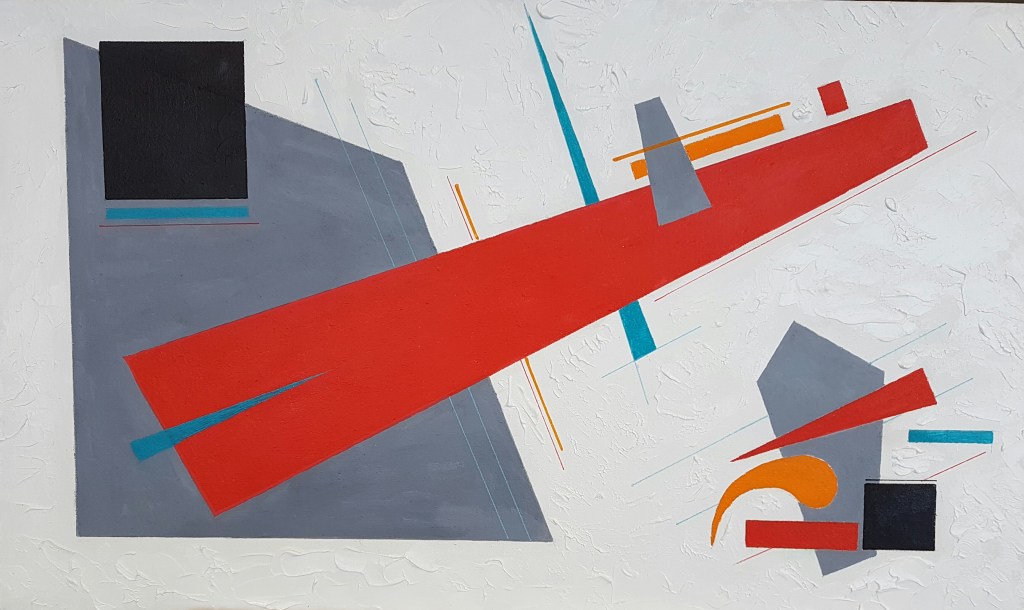
This is Composition No.12. measuring 81cm x 48cm. It is inspired by that great Ukranian artist Kazimir Malevitch.
He was an avant-garde artist and art theorist, whose pioneering work and writing had a profound influence on the development of abstract art in the 20th century. Born in Kiev to an ethnic Polish family, his concept of Suprematism sought to develop a form of expression that moved as far as possible from the world of natural forms (objectivity) and subject matter in order to access “the supremacy of pure feeling” and spirituality. Malevich is also considered to be part of the Ukrainian avant-garde (together with Alexander Archipenko, Sonia Delaunay, Aleksandra Ekster, and David Burliuk) that was shaped by Ukrainian-born artists who worked first in Ukraine and later over a geographical span between Europe and America.
Early on, Malevich worked in a variety of styles, quickly assimilating the movements of Impressionism, Symbolism and Fauvism, and after visiting Paris in 1912, Cubism. Gradually simplifying his style, he developed an approach with key works consisting of pure geometric forms and their relationships to one another, set against minimal grounds.
This painting is for sale. Sensible offers only please to mikerickett007@yahoo.co.uk. Buyers must be prepared to collect or arrange shipment.
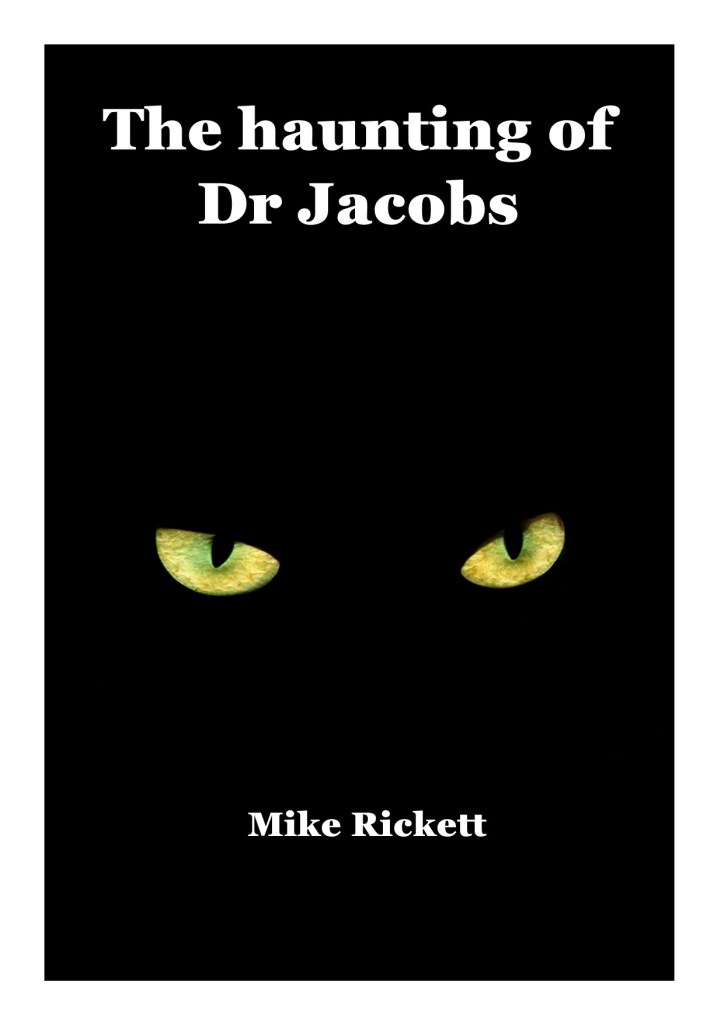
A ghost story for Christmas
I haven’t, in truth, known Dr Irwin Jacobs for very long. I would stop short at calling him a friend because I don’t honestly believe he has anyone he could apply that title too. While appearing outwardly friendly, in reality, he struck me as a very self-contained person; a very private man who only very reluctantly reveals anything about himself.
I first met him in Llandudno in North Wales at a conference on The Study of Personality Disorder. It was organised by SANE, the mental health charity and was attended largely by medics and psychiatrists and others involved in the provision of mental health services. I was there as a freelance journalist with an interest in mental health, having written on many occasions about how destructive it can be to families and relationships.
I literally bumped into him at the hotel bar where he was sitting on a stool staring gloomily into a gin and tonic. I rather clumsily managed to spill his drink which he was about to sip. I naturally apologised profusely and immediately offered to buy him another, but he waved the offer away.
Dr Jacobs has a rather Teutonic face; startling blue eyes, a square jaw and a firm mouth that is not given to smiling. His thinning grey hair sits above a furrowed brow and a sallow face. We shook hands and I apologised again.
I sat on a stool next to him and introduced myself. I am Dominic Howard, quite well known in my chosen field by mental health professionals, even if I do say so with a degree of modesty! After we concluded the introductions, I asked him about his practice. He immediately became quite animated and went into some detail about the problems some of his patients present. It was, however, punctuated by nervous glances around the room, his eyes flickering from side-to side as though expecting a friend or colleague. I looked around but there were just other delegates standing in small groups in earnest discussion.
‘Are you expecting someone,’ I said, standing up, preparing to leave.
‘No, No,’ he said, placing a hand on my arm with a look that invited me to sit. I did so. ‘I thought I saw a cat,’ he muttered, almost under his breath.
I stared at him. ‘A cat?’ I repeated looking around the bar.
‘I’m allergic to them,’ he said by way of explanation, looking around furtively. For some reason I did not believe him but why would he lie about something like that? Our conversation then turned to topics to do with matters of the mind. It ended with us exchanging contact details. As a journalist I have always found it useful to collect people who are experts in their fields and for all his odd behaviour, Dr Jacobs did appear to be highly knowledgeable. We shook hands and parted.
That was a month ago and I have been busy writing a feature on stress at the workplace, a subject close to my heart, when I routinely look at my email queue and there is one from Dr Jacobs inviting me to call round for supper. To say that I am surprised would be an understatement.
I note that Dr Jacobs lives at Bedford Square, which is not that far from my apartment at Ridgemount Gardens, near the University of London. I reply saying that I would be happy to call round. I am curious, more than anything else, to see what life is like at Bedford Square. I note his address is not an apartment!
The door is opened by a man formally dressed. He asks me to identify myself and ushers me into a small but comfortable room to the left of the front door. I take it he must be a butler or manservant. I am astonished that they still exist in the 21st century.
Five minutes later he returns and invites me to follow him to a plush, but rather austere lounge. Jacobs is standing near an open coal fire. He steps forward and we shake hands. He treats me to a rather watery smile and waves me into an expansive easy chair. The Butler, who he addresses as James, is standing nearby awaiting instructions. Jacobs orders two whiskies.
I gaze around the room. It is slightly Edwardian; not quite Victorian but fussy in that everything obviously has its place. Along one wall are shelves full of tomes. I am always fascinated by bookshelves; what treasures are hidden away there, I wonder, and I am sorely tempted to explore, but I don’t. Instead, I look at Jacobs who is staring around the room furtively.
‘Do you hear anything?’ he asks softly.
I listen. There is just a heavy silence which is interrupted by James bringing our whiskies. I stare at him. His face could be made of stone. It is set and expressionless as he sets our drinks down on occasional tables.
‘I am informed by cook Sir, that dinner will be served in 30 minutes,’ he announces in a monotone. Jacobs nods in acknowledgement and James glides out of the room.
‘I didn’t hear anything,’ I inform Jacobs, ‘apart from the occasional car passing outside.’
‘You didn’t hear a laugh,’ he asks, looking at me closely. I shake my head, puzzled, and enquire why he asked.
He stares at a corner of the room. This is a strange house,’ he says. ‘Once the servants have left, I can’t help feeling that there are other people here. I can hear them. Mutterings and laughing, sometimes all night long. There is a cat too. I have no idea how it got in here but I see it every night, lurking in corners.’
I look around the room and then say breezily that there is no sign of any cats now and then ask him how long he has lived at Bedford Square.
‘It was bought by my grandfather,’ he says, relaxing a little. ‘We have lived here for three generations. Both my father and grandfather were medical men. I am the only one to practise psychiatry.’
‘Did you never marry,’ I ask a little hesitantly wondering if he might be offended by such a personal question.
He frowns and replies that he did but that his wife died suddenly just two years after they were wed. ‘It was toxic shock. She died in just two days of the bacteria taking hold,’ he says quietly. I have been alone ever since.’
Suddenly, James appears to announce that dinner is served so we follow him into another spacious room with a dining table in the middle with seats for ten people. There are two place settings at one end. The room is mostly lit by candles, two candelabra on the table and two meagre wall lamps which together manage to cast ominous silhouettes on the walls.
Dinner passes in a gloomy silence and it is with some relief that we eventually rise to leave the maid to clear away the dishes. We return to the lounge which is also poorly lit with just two small wall lights.
His patient involves a delusion that he can transform into an animal. It is often associated with turning into a wolf or werewolf; the name of the syndrome originates from the mythical condition of lycanthropy or shapeshifting into wolves.
‘The patient genuinely believes he can take the form of any particular animal and during delusional periods he can act like the animal.’
I decide to go online and see what a Google search reveals. The first is a news story in which police are appealing for information about Catharine Bancroft, aged 78, who vanished a year ago. I read the story. It seems she told a neighbour she was going to a local shop in south London and was never seen again. The neighbour is later quoted as saying she was devoted to her cat which had also disappeared. It was, apparently, a large black cat which she doted on. It was always with her. I stare at the photograph. There is no doubt about it. She is the spectral figure I saw standing behind Jacobs. And the cat I saw was no doubt hers too.
The second news story that comes up is five years earlier in the Daily Mail saying the actress Catherine Bancroft was retiring from the stage after a lifetime in the theatre. It seems she was a regular in West End productions. It goes on to list many of the shows she appeared in.
So why would she be haunting Jacobs, if indeed it was her I saw? And why did he say she committed suicide, if indeed it was Miss Bancroft he was referring to? The inescapable conclusion, given the documents I found, is that Jacobs was somehow involved in her disappearance but I find that difficult to believe. He may be a little odd but an eminent psychiatrist like him murdering and stealing from a patient is difficult to believe. Surely not. There must be another explanation.
But if she weren’t murdered, what could have happened to her? Suicide is simply out of the question. A well-known actress like her taking her own life would have been certain to have made the headlines.
I scroll through the other news items in which Catherine was mentioned but the headlines get smaller and the stories shorter as time goes on and there is no trace of her. There is only one story in which Jacobs is mentioned and that was when he revealed that she had been a patient of his for some time. No significance appears to have been attached to that.
I decide that I can do no more but I write up my research and file it away thinking that if Catherine does re-appear there will be story in it. I put Jacobs out of my mind and immerse myself in more pressing matters.
It is just a week later when I am sitting in a coffee shop sipping a cappuccino reading the Guardian when my mobile rings. I sigh and am minded to ignore it. I value my thinking time and interruptions are annoying. I glance at the screen which is saying ‘Dr Jacobs’. I really do not want to visit him again in that creepy house of his but I decide to answer and make an excuse, if indeed that is what he wants.
I click on it and listen but all I can hear is an odd subdued, whispered, muttering. I keep saying ‘Dr Jacobs, are you there’ but there is no answer, just the muttering and a strange, rather eery rustling sound.
Then, suddenly, there is scream which is so loud I almost fall off my chair. The two people sitting at the next table glance at me curiously as I hold the phone away from my ear. When I listen again there is just absolute, total, silence. Then I hear a sound that chills me to the bone; it is a sound I last heard in a butcher’s, the unmistakable sound of flesh being sliced. I rush outside and hail a cab, telling the driver to take me to Bedford Square.
I stand looking uncertainly at the door. What am I going to find behind it? Perhaps I should have rung the police first, but then if nothing gruesome has happened despite the scream, I would look foolish. For all I know Jacobs might have just been having a fit of hysterics. Having said that my instinct is telling me otherwise.
There is no movement in the windows; no lights are shining; they just stare down at me ominously. I press the bell and wait. There is no response. I press it again and notice that the door appears to be very slightly open. I push it gently and it swings open very slowly as though by an invisible hand, revealing the cavernous, dinghy hall.
I stare into its gloomy space. There is no movement, no sign of life. I suddenly have an almost overwhelming urge to walk away from this place but I know I must enter; something is compelling me to.
I walk slowly, fearfully, down the hall. I call out to Dr Jacobs several times; there is no answer, just an oppressive, brooding silence. I reach the lounge and stare at the door. I want to turn back; what will I find in there?
As I stand there transfixed, the door gradually opens of its own accord. I step hesitatingly into the room which is in partial darkness due to the curtains being slightly open. At first, I can see nothing in the gloom. I was expecting to see Jacobs in his armchair asleep but the two chairs are empty.
It is only then I notice the smell. It is a sickeningly dry, sweet metallic scent on the verge of being pungent and slightly suffocating, mixed with the odour of burning.
It is only when I walk past the first armchair that I see it. At first, my senses cannot interpret the scene that confronts me. I stare in open-mouthed horror at the carnage that lies before me. Bile rises up and I rush to a plant in the corner and throw up. I leave the room trembling, the scene etched into my mind.
Jacobs, or what is left of him, was lying in the hearth in front of the fire which had been lit and which was casting a red glow on the room.
Embers from the fire had somehow fallen on his chest and burned their way into him exposing a few ribs. He is lying in a pool of blood, but the most horrific sight is his face which has been shredded as if by a claw. One eyeball has been forced out of its socket and hanging down his cheek.
I stumble to the end of the hall into the kitchen and pour myself a tumbler of water. I sit on a chair until my breathing returns to normal and my heart stops its wild beating. Something is telling me to return to the room. I walk to the doorway and there, in the centre of the room, is an elderly woman. I know immediately it is Catherine Bancroft. She is staring at me, tears trickling down her cheeks. At her side is her cat, also staring at me, its eyes no longer glowing. She raises an arm and points to the floor and they both slowly disappear.
It is two weeks later that police discover a body in the cellar. It was quickly identified as that of Catherine Bancroft. I had some difficulty persuading them to search the cellar without revealing that it was Catherine herself who pointed it out. The half-burned documents I produced persuaded them that it was a possibility that Ms Bancroft had been murdered.
At the inquest, forensic scientists were unable to satisfactorily explain how Jacobs sustained such horrific injuries. An open verdict was recorded.
Just two days later, I found myself wide wake at 2.00am. I glance at the window. I always leave the curtains half drawn to let in light. The moon’s rays cast a sombre light on the opposite wall. I stare at the windowsill.
A cat is sitting there.

Copyright © 2025 Mike Rickett
All rights reserved.
1968
I last ran into Montague Stephens almost a year ago. We bumped into each other in London after a Mozart concert at St Martin-in-the Fields. I was idly standing around clutching a glass of mediocre wine afterwards when he sidled up alongside me. I introduced myself. He looked at me and murmured my name Michael Thorne thoughtfully, his head to one side. I spared him the torture of attempting to recall where he had heard or seen it and told him that I used to be a reporter which is where he no doubt saw my by-line. He nodded, obviously relieved and we enjoyed a really pleasant chat about the relative merits of Mozart and Faure, the latter being my favourite composer.
I was working in London at the time at a PR consultancy in Red Lion Street and he was a history lecturer at the London School of Economics. After the concert we would meet up occasionally for a few drinks and a chat, usually somewhere in Holborn which is where we both lived, until a new job beckoned, and I found myself once again back in Liverpool.
That was six months ago when I rented a really spacious apartment in an area which the newspapers termed ‘Leafy Allerton’ in that jocular way they have of attaching labels to everything.
It is, however, undeniably a ‘leafy’ area and just down the road, nestling in a crossroads, is a historic church built by the 19th century shipowner and merchant John Bibby. It was apparently built at the-then enormous cost of £25,000 as a memorial to his wife whose catafalque lies behind the altar.
I love buildings that have a ‘history’ and this one is a prize example, for quite apart from the founder’s reason for building it in 1872, the church is full of remarkable art in the form of fabulous Arts and Crafts stained glass windows, largely the work of Sir Edward Burne-Jones and Williiam Morris, the founder of the pre-Raphaelite movement.
Anyway, I started going there of a Sunday morning to enjoy Matins and the choir’s singing of the Venite and the Te Deum and Benedicite or the Benedictus or Jubilate Deo. I was a chorister myself as a boy, so I appreciate a good choir.
Anyway, last Sunday I was somewhat surprised to spot Montague in a side aisle before the service staring fixedly at a statue in the south transept. I had no idea he had left London, so I strolled up and gave him a dig in the ribs. ‘You sly dog,’ I said smiling. ‘Why didn’t you get in touch? I had no idea you were in Liverpool.’
He stares at me vacantly, his eyes glassy until he suddenly appears to realise I am there. ‘Sorry Michael,’ he mutters, ‘I was admiring that sculpture over there.’ He points at what looks like a marble group of figures. I walk over and read the caption, An Angel Carrying a Soul to Heaven. It was carved by the Italian artist Fabiani and is a replica of the one in Genoa.
It must have cost the founder Mr Bibby a small fortune.
‘Magnificent isn’t she?’ he breathes, standing next to me. ‘I can’t take my eyes off her. The church authorities apparently call her ‘Flossie,’ can you imagine that? Disgraceful and insulting,’ he declares indignantly, looking around hoping somebody was within earshot. Nobody is.
He moves a short distance away and summons me to join him. We have our backs to the statue, and he is pointing to a pew just two rows from the front and at the end next to the central aisle.
He lowers his voice to a whisper. ‘I was sitting there last Sunday morning,’ he says sibilantly. ‘The choir had just started singing the Te Deum, do you know it?’ I nod in the affirmative.
‘Well, as you know, when it gets to part where the angels sing God’s praises, I felt a kiss on my cheek. I jumped and looked around but there was nobody there.’
‘You must have imagined it,’ I say to him. ‘It might have been a gust of wind from the Bibby side door over there.’ I point to the door by the vestry.
He shakes his head vehemently. ‘I know what lips feel like. And it was definitely a kiss.’ He stares at me fixedly. ‘It was her,’ he says nodding in the direction of the statue.
I burst out laughing. ‘Don’t be silly Montague. The Angel is a marble statue. They don’t usually suddenly come to life and start kissing people.’
‘I know what I felt,’ he says abruptly and marches off to the door. I turn and stare at ‘Flossie.’ She is certainly beautiful but definitely immovable. I shrug, thinking that poor Montague must be losing it.
It is almost a month later when I next see him. It is a Saturday, mid-December and I am on bustling Allerton Road, full of people with their eyes firmly focussed on the last few shopping days before Christmas. I had just been to the fishmongers for my weekly treat of Manx kippers when I spot him trudging along outside, his head bowed, the very picture of melancholy.
I catch up with him. ‘Montague,’ I call. He stops and turns, and I am disturbed at the change in him. His face is a pasty white and there are yellowish bags under his eyes.
I suggest we go for a coffee. He reluctantly agrees. When we are seated I stare at him. ‘What on Earth has happened to you? You look dreadful. Are you ill?
He smiles grimly. ‘I suppose you could say that.’ He takes a long gulp at his coffee and studies the people around us, muttering: ‘She will be here somewhere. You can’t always tell but she will be watching me. She always is.’
I look around. The café is quite full; there are people in ones and twos, all doing something; chatting, reading, or simply looking at the passing scene outside.
‘Nobody is taking the slightest bit of notice of us,’ I say, hoping to reassure him. Who do you think is watching you; who is she?’
He glares at me. ‘Who do you think? That bloody statue.’ He sighs and slumps in his chair. ‘That first night after I studied her in church. I woke at midnight. I felt something was wrong. I sat up in my bed. I always have the curtains and window slightly open. It was a full moon and there was a shaft of light shining in my room and there in the corner there she was, staring at me. There was something about her eyes. She wanted me to look at her, but I knew that if I did I would be lost. Then she began getting closer, her wings outstretched. I was terrified. I ran out of the flat on to the street in my pyjamas. One or two people walked past even at that time and stared at me curiously.’ His brow is furrowed as he gives me a pleading look.
‘You know, I think she wants me to join her,’ he whispers.
I am about to make a joke of it by saying she might be doing him a favour by taking him to Heaven, but I don’t. Instead, I say gently: ‘Are you sure you aren’t imagining all this? You might have been overdoing things at the faculty lately. I know there’s a lot of pressure to get Firsts these days. Maybe you should get medical help. Go and see your GP. I’m sure they will suggest something,’ I end a little vaguely.
He reaches into an inside pocket and produces a large, pure white feather. He places it on the table. ‘That was on the floor in the morning,’ he says. ‘Do you still think I imagined it?
I am lost for words. I stare at it. ‘Monty, I assume you mean Flossie by She, don’t you?’
‘Don’t call her that,’ he snaps. ‘She doesn’t like it.’
I frown. ‘Whatever you want to call her, she is a marble sculpture.
Nothing more. She can’t suddenly come to life. It is just impossible.’ I pick up the feather and hold it up. ‘And this could quite simply have blown in through the window. It looks like a seagull feather to me.’
He snatches it back and scowls, backing away. ‘You don’t believe me, do you, but you will, just wait and see.’ And with that he slinks off.
I am in a quandary. I am worried about him. I find his story difficult to believe and the following Sunday morning I stare at the statue. It is, without a doubt a beautiful piece of work. I wonder why they called her ‘Flossie.’ It seems completely incongruous for something so beautiful. As I stare, her face turns towards me, and she smiles.
I shake my head. I must have been dreaming. I look again and she is unchanged, her finger pointing to Heaven for the departing soul.
After the service I seek out the vicar, the Rev Maurice Bartlett. We are good friends. He was appointed two years ago and we hit it off almost immediately. He prepared me for Confirmation as well as marrying me to the wife I later divorced. He is an intelligent and likeable man, and as a former Guards officer, is well versed in the ways of the world.
We both enjoyed a lively debate, and I would rather impudently introduce topics like ‘What is God?’ usually accompanied by a whisky or two.
Anyway, I decide to ask if we could have a chat and later, in the early evening, I call around to the vicarage.
Once we have dispensed with the preliminaries, I tell him about Montague and his fantasy which is what I have decided to call it.
After I have finished he is silent for a while. Finally, he frowns. ‘He isn’t the only one to think there is something about ‘Flossie.’ One or two people have said they have had disturbing dreams about her, to the point in one or two cases, where they have even stopped coming.’
I am astonished and ask him if he is serious because Maurice can sometimes be a bit of leg-puller. He assures me he is.
‘There is something else too,’ he continues. One or two people who have been in the church of a night when just one or two lights are on, and they say they have felt a presence there and usually leave as soon as they can.’
‘Have you ever felt that?’ I ask. ‘You must have been there many times on your own.’ He grimaces and says he honestly hasn’t. ‘Maybe the presence is scared of me,’ he says grinning.
‘Maybe it’s Fanny Bibby getting out of her catafalque,’ I respond. ‘Perhaps she and Flossie get together for a bit of a chinwag when nobody is around. We both laugh at that thought.
He is looking thoughtful. ‘There is something else too that has been reported to me. A strange light has sometimes been seen in the North Chancel window. No other light have been on in the church, just in that window.’
He studies me. ‘You probably don’t understand the significance of that. That window was installed by Burne Jones in 1881. It depicts angels and is a memorial to John Bibby’s children.’
He looks at me questioningly. ‘Angels again you see. If you are looking for a reason, maybe that’s it.’
‘So, it comes back to “Flossie again.’” I say. He nods.
I sigh. ‘So, you are saying that it is distinctly possible that Montague isn’t imagining all this. Is that right?’
‘Oh well, I wouldn’t go that far,’ he says hurriedly. ‘It is entirely possible he has some kind of mental disorder which has magnified the stories about ‘Flossie’ he may have heard. He really needs to see a doctor.’
It is exactly the same conclusion I had come to, and I told him so. I stare at him quizzingly. ‘Do you actually believe all the stuff you’ve told me?
‘Let me refer you to the Bible,’ he says. ‘In my Father’s house are many mansions: if it were not so, I would have told you. I go to prepare a place for you. And if I go and prepare a place for you, I will come again and receive you unto myself; that where I am, there ye may be also. And whither I go ye know, and the way ye know.’
‘Is that a “yes” or a “no”?’ I ask.
‘I’ll let you decide,’ is his response.
On my way back to my flat, my thoughts return to that odd dream, if that’s what it was, I had in the church. It can only have lasted for perhaps a few seconds and then the statue was back to normal. I shiver.
Back in my flat I notice there is a message on my phone machine. It is from Montague. He sounds agitated. I press callback but it just rings out. I decide to go around and find out what the problem is and why he isn’t answering his phone.
When I get there he is sitting on his step, his head in his hands. ‘She won’t leave me alone,’ is all he says pleadingly, nodding inside. I assume he means ‘Flossie.’
‘What do you mean? I ask.
‘She is in my room all night. I am too scared to close my eyes. I don’t think I would wake up.’ I shake my head and sigh. I tell him I will go and look around. I’m not sure what I expect to find.
There is nothing unusual in any of the rooms. I join him on the step and tell him that everything is entirely normal and then an idea comes to me. ‘Why don’t you go away for a few days; a week perhaps? Do you have anyone you could stay with for a while? You don’t have to tell them exactly why; just tell them that you urgently need a break.’
‘There’s my sister Polly in London,’ he says slowly. I tell him to ring her straight away and if she agrees I will run him to the station. He disappears inside and returns. He asks me to go with him while he packs a bag. I takes him just ten minutes.
I drop him off at Lime Street Station. His demeanour has completely changed. He was smiling broadly when he climbs out of the car, and I congratulate myself on a problem well solved.
The following Sunday I go to church. It is Matins as usual but this week with the addition of the Eucharist following. While the choir are singing I stare wonderingly at the statue. I was about halfway down the Nave but even at this distance I can tell there is that indefinable something about her. I know this sounds insane, but I can almost feel her studying me.
At the end of the service, I seek out Maurice and update him on Montague. He agrees that it was exactly the right course of action.
That night I watch the BBC’s excellent annual ghost offerings. It is always one of M R James’ s creepy ghost stories. This year it is The Stalls of Barchester. A scholar, Dr Black is engaged in cataloguing the collection of the library of Barchester Cathedral. He is finding the work heavy going. However, the librarian and Dr Black begin reading the diary of Dr Haynes, an ambitious cleric who finds his promotion to Archdeacon blocked by a geriatric incumbent. The impatient Haynes, played by Robert Hardy, conspires to hasten the Archdeacon’s death and is duly appointed Archdeacon. However, his diary reveals that once in post Haynes becomes increasingly disturbed and is plagued by unnerving events, including a phantom cat, and carvings coming alive in the cathedral stalls.
I’m not sure whether it was that or ‘Flossie’s’ alleged hauntings, but my night was extremely disturbed. I awoke at 2.00am, or I thought I did but I can’t be sure. I may have been dreaming. It was a sound in my room I think, a strange rustling. I glanced at my window which I always leave slightly open, thinking that perhaps a bird may be in the gutters. But the sound wasn’t coming from there; it appeared to be nearer the door.
My room is never completely dark, even though my curtains are drawn. A lamppost outside casts an orange glow which permeates through my curtains. The orange glow is brightest on the door, almost opposite my bed. As I stare at it, I can see the door handle slowly moving. I gaze in horror as it stops, and the door gradually begins to
open. ‘Who’s there?’ I shout. I follow it up with ‘I’m ringing the police.’ I stand by the side of my bed.
The door is open wide now. Beyond is the hall in a blackness but as I stare, I can see a shape or shapes which are moving or writhing. I scream and fall onto the bed.
The sun is shining through my curtains. I am lying on my bed. Why am I on the bed and not in it? And then I remember the nightmare. Was it a nightmare? I’m not sure. It is all a bit fuzzy. I recall it had something to do with the door. I glance at it, but it is firmly shut.
I have a feeling of unease or dread, and I don’t know why. I search every room in the flat. I’m not sure what I expect to find but everything is as it should be.
I go to work which is taken up with the demands of a client in the form of the Plessey company on Edge Lane. The nightmare fades as nightmares so often do and the following nights are undisturbed which convinces me that it was all in my imagination.
The following Friday there is a message on my phone informing me that Montague is back home in his flat after a ‘really enjoyable week’ and would I fancy a pint or two a little later? I ring him later and we agree to meet up in the Rose of Mossley pub on Rose Lane.
I almost fail to recognise him when I spot him leaning on the bar. He is all smiles, transformed from the introspective, gloomy man who had set off to London. ‘You know, I think you may have been right,’ he informs me when we are sitting down. ‘I really do think it may have all been in my mind.’ I have to stop myself telling him about the ‘incident’ in church when I imagined ‘Flossie’ smiling at me.
He tells me he is moving back to college in London next week and I am welcome to visit whenever I want. I thank him.
As we part I ask him if he is likely to be paying All Hallows a final visit on Sunday. He stops and he stares at me strangely, an odd expression I cannot quite define before saying quietly: ‘I think not.’ And with that we part.
The following Monday my phone rings as I am about to go to work when my doorbell rings. Outside are two men who stare at me grimly.
‘Mr Thorne?’ It’s more of statement than a question. He produces a warrant card and introduces himself as Inspector Dean and his colleague as sergeant Finney. He asks if they could come in ‘for a chat concerning Mr Montague Stephens.’ I lead them into the kitchen and look at them expectantly.
‘We understand you are a friend of Mr Stephens,’ the inspector says. I nod. ‘When did you last see him?’ he then asks.
I briefly recount our conversation the previous Friday and tell them that he was intending to return to his college today. I raise an eyebrow expectantly and ask if anything is wrong.
They exchange glances. ‘I’m afraid we have some rather bad news,’ says the inspector. ‘Mr Stephens was found dead earlier this morning.’
I am stunned. ‘He was fine on Friday and in perfect health. What happened?’
‘We aren’t sure. As yet we haven’t been able to establish a cause of death. There is no sign of a disturbance despite a neighbour hearing shouting and a cry for help which is why he contacted us.
The pathologist was unable to throw any light at the scene. We will know more after a postmortem. Our immediate task is to notify next of kin. Would you be able to help with that?’
I tell him that he had just returned from visiting his sister in London and that the London School of Economics would undoubtedly have details. He nods and they turn to go. As they are about to walk out, he turns: ‘There was just one thing. He had a very odd expression on his face; both his eyes and his mouth where wide open as though something had deeply shocked him. I’ve never seen anything quite like it.’ He shakes his head mournfully and they leave.
It was a few days later that I learned that the postmortem decided he died from cardiac Arrhythmia or seizure, but they were unable to say what caused it.
I am disturbed. What could have happened to him? Inevitably, my thoughts turn to ‘Flossie.’ Could she have had something to do with it? And just as speedily, I dismiss it. That is just too ridiculous for words. It was probably a heart attack. I know of people who have literally dropped dead on the spot because of that. What is the betting that is what the PM will find. All the same, I feel unsettled for the rest of the day and decide to call on Maurice at the vicarage later.
He agrees with my diagnosis when I outline what the police have told me. ‘He was obviously a very disturbed man,’ he says quietly. ‘I shall pray for him.’ He then treats me to a calculating look. ‘You mustn’t let all this get to you. You did what you could to help him. You have nothing to reproach yourself for.’
The following day, a Saturday, is spent in Liverpool’s Central Library researching the science behind wire-free communications for the Plessey company, something that promises to revolutionise life in the future.
That evening is very disturbed again. I can’t relax and I have no idea why. I have the feeling I am not alone which is crazy but all the same I keep imagining I see movement out of the corner of my eye but when I turn to look there is nothing there. Am I imagining it? All this business with Montague has really unsettled me. I decide on an early night. Perhaps things will feel better in the morning.
I awake suddenly. I’m not sure why; was it a noise or something else? I’m not sure. I do know it is very cold and a shaft of moonlight shines coldly through the gap in my curtains lighting up something moving on the opposite wall. I sit up and stare. At first it looks like an image of something grotesque, a writhing mass of flesh which gradually coalesces into a pair of eyes which protrude from the wall and are slowly surrounded by a pair of wings and then an upper female body.
The eyes bore into me and the entire apparition begins to slowly move towards me until it reaches the end of my bed. I shrink back and try to scream but I can’t because my throat is so constricted all that emerges is a dry croak. I lurch sideways and fall onto the floor, banging my head on something hard.
I awake on the floor. I am cold, very cold. Daylight is streaming through the window. What am I doing on the floor? I am trembling and stand, reaching for my dressing gown. It is then I remember the nightmare. I must have fallen on the floor when I was writhing in bed.
But was it really a nightmare?
It must have been. I stare at the wall. All nightmares are vivid at first and then become a little fuzzy. I close my eyes, and I can still see the apparition. It didn’t feel like a nightmare. It was just so real. I shudder.
I decide to go to church after breakfast. The walk will do me good anyway and, hopefully, the uneasy feeling that has descended on me will dissipate.
I choose a pew on the opposite side of the church from ‘Flossie,’ and I am also behind a pillar so that I do not have line of sight of her. I’m not sure why. I just feel I want to distance myself from the statue. I am also at the end of the pew next to a side aisle.
The uneasy feeling has failed to dissipate; if anything, it becomes stronger as the service proceeds.
The choir start singing the Te Deum and as they sing: ‘To thee all Angels cry aloud: the Heavens, and all the Powers therein. To thee Cherubin and Seraphin: continually do cry.’
I am staring at the pew in front of me and suddenly fingers begin slowly crawling their way over the top. At first I assume there must be a child sitting there, but there is nobody there. I stare at them in horror; they are a deathly white, slightly green as though rotting.
It is then I feel a kiss on my cheek . . .
About the author
Mike Rickett is a member of All Hallows Choir. He is an artist and a writer. He was previously a daily newspaper journalist and at one time was head of public relations for National Girobank and PR Executive for the Plessey Company.
The first of the ghost stories

February can be an odd month these days; odd in the sense that you never quite know what to expect as far as the weather is concerned. Take today, for example. It is the middle of the month and yet the sun is shining brightly, and it should have felt warm outside but there is a cold, merciless wind blowing from the north and everyone is wrapped up in their fur-lined coats
Yesterday by contrast, threatening clouds loomed overhead which in past years would have almost certainly been a portend of snow but there was nothing but cold rain that seeped through to your bones. When I was a little girl, I would have been certain to be building a snowman with my dad this time of year. Maybe there is something to all the climate change furore after all.
I am Naomi Richards and I am an artist and psychic but before you snigger or move on to something else, I should say in my own defence that I tend to play down my psychic abilities because people are inclined to think I am either slightly bonkers or a charlatan. And I assure you I am neither.
Also, art is something I have toyed with all my life in an amateur way; something I did almost as a means of self-expression; a way of formalising my feelings about people and life in general, especially during the uncertainties of my teenage years. It was only after my painful divorce that I decided to take it seriously by spending six years in university winding up with a Masters.
I sell a canvas now and then and people appear to like my work but, sadly, not enough to pay the bills for my apartment on Liverpool’s Rodney Street, a fashionable address in consultant land in the city centre with the majestic Anglican cathedral just down the road. Not that I am on the expensive ground floor you understand. No, I reside on the first floor which is two flights up but that’s OK. It’s still a good address from which to run my other business which is my psychic consultancy. Sounds rather posh and pretentious, doesn’t it? But I assure you it isn’t. I just help people if I can; people who are bereaved or in pain or who are lonely or troubled.
You may be tempted to think that I am eerie old lady with a moustache, wearing a pointy hat with a broomstick in the corner and, of course, the mandatory black cat. But I have none of those, not even the cat and especially not the moustache. I am actually in my late twenties (28 if you really must know) with light brown hair combed back in a bushy ponytail that hangs half-way down my back. People have been known to remark on my eyes having a magnetic quality. I wouldn’t know about that. I just know they are grey. I’m not a large lady either, nor am I skinny. I think I have a pretty good figure actually; not one you would perhaps associate with the dark arts. (Whatever they are!).
I find it difficult to explain my psychic abilities to people because it is something I have lived with all my life. When I was little, I was terrified by the voices I heard and the things and images I saw. At first, I thought it was something that happened to everyone but then when I told my mum what I was seeing or hearing she would stare at me warily with a very worried look on her face. She dragged me off to our GP and then to a variety of consultants who all declared that they could find nothing wrong with me. It was then I realised that it was just me seeing and hearing things. After that, I learned to keep my mouth shut.
As I grew older though I began to realise that I should not be frightened and that I could use my abilities. I knew instantly who I could trust and who I could not, for example. I knew my husband was cheating on me long before I dragged it out of him. And I very often know when something is about to happen. They happen as images in my mind – I call them flashes – which last for perhaps a second or two – and then they are gone. It would then be a day or two later that the event or events would happen. These days I am sometimes called in by the local Police when a person, especially a child, goes missing and sometimes I can help locate them and sometimes I can’t.
Anyway, I am gazing out of the window of a south Liverpool pub watching all the activity as shoppers hurry past in the cold February sunshine with heavy bags from the nearby shopping centre. I am sitting at my usual table by a window with the sunshine casting a golden glow on the table in front of me. It is one of the monthly psychic sessions I do here, and I have a full list as usual. Most of them will be my ‘regulars’, mostly elderly ladies but by no means exclusively so. I do get men too wanting to know how what their careers have in store for them and girls wanting an insight into the latest or prospective boyfriend. It’s a mixed bag and it greatly helps to pay the rent!
The sessions are organised by Sid Driscoll, a man with a colourful background which a bent nose and a cauliflower ear testify to. He is not a man to get on the wrong side of but he’s an asset at these sessions in that he is more than able to deal with any troublemakers. I call him Sid the Fixer! Not that it is a potential problem here, but it can be when we hold sessions in the city centre when drunks come in ‘for a lark’.
My first customer is Betty, an 85-year-old regular who lost her husband almost 20 years ago. I think she is basically lonely and comes in for a chat apart from getting in touch with her husband. It always brings tears to her eyes and Sid invariably brings her a cup of tea when I give him the nod. He will chat to her and by the time she leaves she will be laughing.
The rest of the evening goes smoothly as it usually does until an unexpected client suddenly appears in front of me. I am reading a few notes and am about to pack up when I look up and there she is. I look at my list and I have seen everyone on it. Sid must have taken on a latecomer without telling me. I shake my head a little impatiently and look at the woman who is gazing at me in an odd way, almost as though she is looking through me with eyes that do not blink. I can feel a shiver along my spine. She is probably in her 50s with iron grey hair, a deeply lined face and a threadbare brown coat. I clear my throat rather noisily and ask how I can help her. She doesn’t reply but instead lifts an ancient handbag and pulls out a cutting on a yellowed paper. She slides it across the table to me and I stare at the headline which says. Housewife vanishes. And then, underneath Mother of two goes for a walk and is never seen again.
I am about to read the story underneath but instead I look up intending to ask why she has brought it to me but there is nobody there. I look around at the other tables, but they have all packed up and left. There is just me and Sid, sitting on a stool at the far end of the bar, enjoying a pint. I put the cutting in my bag and walk over to him. ‘Fancy a pint,’ he says, grinning, displaying a row of uneven teeth.
‘No thanks Sid. Some other time. ‘Who was the latecomer you sent over without telling me,’ I say, a little annoyed.
His brow furrows and he stares at me as if I’m mad. ‘Eh! I didn’t send anyone over luv. I would have asked you first, you know that.’
‘Well, a middle-aged woman appeared at my table, didn’t say a word, just handed me a cutting and then disappeared.’
He shrugs. ‘I didn’t see anyone. Last I looked at your table you were on your own, reading something by the looks of it. I wouldn’t worry about it. Sure, you don’t want a drink?’ I shake my head and sigh. ‘Thanks anyway Sid. I’m tired. See you soon.’
I walk down the road to the bus stop and within minutes I am on my way to Rodney Street. I slowly start to climb the two flights of steps at number 18 but as I do, I can hear steps on the stairs behind me. I stop and look down the stairs but there is nobody there. I must have imagined it. I carry on up and open my door and switch the lights on. My first action is to put the heating on. It is freezing outside and not much warmer in here. I leave my coat on until it warms up a little. I make a coffee and settle into my favourite chair and switch the TV news on.
I feel unsettled and I don’t know why. I look around the room, but it looks the same although is it my imagination or does the corner opposite the windows look darker than usual? Is that a rustling sound I can hear? I shake my head and decide it is all in my imagination and then I remember the cutting the strange lady gave me. I dig around in my bag and look at it under the lamp alongside my chair. The paper is yellowed so it is obviously at least five years old I would say. Maybe even older. I read the story. It seems the missing woman’s name was Nancy Derebohn and her husband is quoted as saying she left the house one night saying she was going to visit her sister a few streets away, but she never arrived. A search of the neighbourhood revealed nothing.
I decide to Google her name to see what comes up and I discover that Mrs Derebohn vanished fifteen years ago which explains the age of the cutting. There were no sightings of her and while the Police suspected foul play no body was ever found. Later reports said that her husband Roy was questioned but released. It seems she is still officially a missing person. It is then I come across the picture of Mrs Derebohn. It is the lady who came to see me. No doubt about it. Was she a spirit? Although spirits hold no fear for me, I am feeling slightly uneasy. I shiver.
It is late so I decide to turn in. I walk over to the windows and gaze down at Rodney Street. The old-fashioned gas lamps, now electric, bathe late night pub and club goers in pools of frosty light. Very soon, even Rodney Street will be still and silent. I draw the blinds and head for my bedroom where I partially draw the curtains. I have never really liked a totally dark bedroom and I like the shafts of light from the streetlamps below. It stems from when I was a little girl when I was constantly afraid of what I might see in the dark.
I take a hot water bottle to bed with me and soon its warmth has suffused its heat under my duvet, and I snuggle down and lull myself to sleep thinking about my latest canvas.
It must be 2am when I awake with a start. I sit up in bed rubbing my eyes. Was it a noise or something else that woke me? The shafts of light are shining through my window and it is quiet – too quiet. Silence can come in many forms I find – it can be menacing, suffocating or it can be welcoming or comforting but this silence is different. It has an expectancy about it. All my instincts tell me that something is about to happen. I look around my room. It is then that my eyes are drawn to a dark corner by the door where there is an even deeper darkness, beyond the shafts of light from the street lamps.
There is something there; it begins to coalesce into a vague amorphous shape; transparent and very slightly glowing. As I watch, it gradually takes shape and glides slowly towards me until it reaches the foot of my bed. It is the lady who appeared at the readings yesterday; Nancy Derebohn. Once again, her eyes bore into me. I ask her softly what she wants of me and then, after the silence continues, how I can help her. By way of an answer, in my mind I see a street; a row of terraced houses and then a front door, No 92. I know she wants me to go there. I am about to ask her why when a feeling of terror and desolation hits me like a wave, and I hear a howl of anguish. It is so strong I gasp and close my eyes. Something terrible happened to her. I know it. I can feel it. I open my eyes and she has gone. I decide to get up and make a cup of tea. I cannot sleep after that experience.
I cradle the hot cup in my hands and search for the cutting that Nancy gave me. I know the number of her house and I know it is in Liverpool, but I don’t know which street. I look at the cutting again and eventually I find it – Freshfield Road. I find it on Google maps and discover it is not far from the pub I give readings in. I shall pay it a visit tomorrow.
As it happens the following day is bright and sunny and I am busy with things artistic, which includes looking at a studio I am considering renting, so by the time I get back to Rodney Street it is early evening and the shadows are getting ominously longer on the buildings opposite.
I have a hurried egg and chips with a couple of slices of ham with a large mug of tea. I really don’t care if it isn’t trendy. It’s filling and its cheap and that’s all that matters. I get the bus at the bottom of my road and head for south Liverpool. By the time I am walking past the pub on my way to Freshfield Road it is getting dark and the street lights are beginning to switch on.
I reach number 92 and it looks very dilapidated, dirty windows, peeling paint and a general uncared-for appearance. I wonder if, in fact, anybody lives there and how I explain my presence if anybody does come to the door. I really can’t say that I saw a ghost last night who told me to come here because I’m sure the door would be very swiftly slammed in my face. I decide I will simply ask for Mrs Derebohn and see what response I get. I have just realised there is something strange about the street. There is no sign of life. There are no lights and no cars either. All very odd.
I climb a couple of steps and look for a bell. There isn’t one so I knock. I can hear the sound echoing around inside. I wait but there is no response. I decide to knock once more and to leave if there is still no response.
I knock again, louder this time, and just as I am about to bang the door again, it opens slightly. I stare at it and push it open revealing a blackness. I call asking if anyone is there but there is just a stony silence. I look up and down the street, but it is empty. The lights glimmer dimly, and it is now getting dark. I stare at the stygian blackness in what I suppose is the hall. I can feel the hair at the back of my neck rising. I don’t want to enter but I also know I must. I leave the front door wide open to give at least a little light. I tread warily into the hall, feeling my way. The silence is absolute and oppressive. There is a doorway on my right which I decide to ignore and then, in front me is the stairs. To the right is another door which I push open and gingerly tread my way into what I assume is the sitting room. Something brushes my face and I put my hand to my mouth to stop myself screaming.
A little light from the window shines grimly into the room. I can hear a voice, a man’s voice, faint but growing louder. Then, suddenly standing in front of me, is a tall, gaunt, heavy-set, unshaven man, his teeth bared. He is calling me a slut, a whore, he raises his hand and I flinch as it passes through me. His face is contorted in fury, flecks of white at the corners of his mouth. He bends down towards the fireplace and is now holding a poker which he brings down on my head, once, twice, three times. I look down at the floor and there is a body of a woman, her face looking up at me. It is Nancy. Now I know why she wanted me to come here.
I run out of the house, tears streaming down my cheeks. I run up the road until I reach the end and suddenly there are lights, traffic, people walking; people talking; people laughing. I stop and lean against a wall and bury my face in my hands.
‘Are you alright luv,’ says a kindly lady who stops, a concerned look on her face. I nod, smile wanly and assure her that I am and that I will be fine in just a minute or two. She looks uncertain and walks on.
As I walk, I begin to wonder if all that was a dream. The house and indeed the entire street for that matter. I doubt very much whether either are really like that at all so what have I just experienced? Some sort of elaborate psychic message? Was it all in my mind? Indeed, did it happen at all? I am tempted to turn back to see if the street has changed but I decide to go home. I am tired and feel completely drained.
Surprisingly, I slept undisturbed and woke feeling refreshed. As I sit at my table sipping my morning cup of tea, munching toast and marmalade, I find myself thinking about Nancy Derebohn and her anguish which I can now understand. She was brutally murdered by her husband and her body hidden somewhere. That must be why she has shown herself to me. I gaze out of my window at the patch of azure sky I can see above Rodney Street. I know I must go back and see the house as it is today. I make my mind up. I will go this morning after I have done a brief shop for necessities. My fridge is forlornly empty, and I have even run out of staples like bread and soup. On the rare occasion I see my brother who lives in Snowdonia, he keeps telling me I have lost weight. Maybe I have. It is just that sometimes I am just too busy to eat. Yes, I know I should make a point of having at least one good meal a day and I do try.
The bus takes me within walking distance of Freshfield Road, this time in broad daylight with a blue sky and a gleaming sun shining down. No macabre visions this time surely?
The road could not be more different to the one I walked down last night. There are cars lining one side; people are walking; people are talking; it is all bustle. I smile and then when I am within sight of number 92, I stop in my tracks. What do I say to whoever opens the door? I hadn’t thought of that. I can’t tell the whole story; not at first anyway because the occupants will think I’m mad. I think for a few moments and decide on my approach.
When I reach the house, it could not be more different. It is brightly painted with modern double glazing and curtains at the windows. And there is a bell.
I hesitate and then, my mind made up, I press it a couple of times. There is no response, although I think I can detect movement. I stand there undecided. Should I just go? I have turned on my heel when the door suddenly opens and a flustered-looking woman in her early 20s looks at me enquiringly. I clear my throat and say that I am sorry to bother her, but I wonder if I might have ten minutes of her time. When she looks at me blankly, I plough on and say that it is about a woman who used to live at this house by the name of Nancy Derebohn and that she might be able to help solve a mystery.
She frowns as if trying to decide if I am for real or not. She asks me who I am, so I tell her but leaving out my psychic abilities…for now anyway.
She opens the door wider and ushers me into the sitting room which is bright, cheerful with a couple of comfortable armchairs and a sofa. So different from my last visit.
‘I have just put the baby down,’ she says smiling. I fervently hope she means the baby is asleep and not dead. ‘Mornings are always a bit hectic, especially when I’m working. I am Alice Worthington by the way,’ she says holding out her hand. We shake, smiling. ‘Now, how can I help you,’ she says. ‘You mentioned Nancy Derebohn. I know she and her husband used to live here.’ I nod. ‘And then, apparently, one day she just vanished.’
‘I think she was murdered,’ I say, deciding to take the plunge. ‘And I suspect it was her husband who killed her, here in this house.’
She stares at me, a look of horror on her face. ‘Here,’ she whispers, looking around.
Quite possibly in this room,’ I continue sighing. She puts her hand to her mouth and then a perplexed look crosses her face.
‘Can I tell you something,’ she says. I nod. ‘You must promise you won’t laugh though,’ I tell her I won’t and look at her expectantly.
‘I think this house is haunted,’ she says. ‘There are quite often rappings on the wall behind you when there is nobody in the next room and things have disappeared and very often, I can feel as though there is somebody here.’
‘Yes, I can feel it now,’ I say.
‘You can?’ I nod.
‘A few months ago, I friend of mine was here staying the night and she saw a grey lady who she said looked very sad.’
‘I saw her yesterday,’ I say, coming to a decision. ‘What I haven’t told you is that I came here yesterday but neither the house nor indeed the road looks like they do today. I’m still puzzled by it quite honestly.’ She stares at me, her eyes wide.
Then I told her about how I saw Nancy’s murder being enacted in this very room.
‘Oh my God,’ mutters Alice, looking around again.
I put my hand on her shoulder. ‘It’s OK,’ I tell her. ‘You have nothing to be afraid of. Nancy wants justice. That’s why she is haunting this place and that’s why she has appeared to me several times.’
Lucy stares at me. ‘Would you like a coffee?’ I nod and she disappears into the kitchen and I can hear the kettle being put on and mugs being arranged.
When she returns, she hands me a piping hot mug. ‘How do you know all this?’ she says. I explain that I am a psychic investigator and that Nancy first appeared to me at a pub reading not far away.
When I have finished recounting the chain of events that led to me coming here, she leans back in her chair and then suddenly stands up and says she wants to show me something. We walk over to the window and she points to a well-kept lawn outside.
‘Do you see the flowers,’ she says. I look at the lawn and there is a yellow rectangle of buttercups in the centre. ‘They are pretty,’ I say. ‘We never planted them,’ she says. ‘They are always there, whatever the weather. Really strange.’
I ask if we can walk outside and when I look down at the flowers I know, without any doubt, that is where we will find Nancy Derebohn.
I tell Alice and she stares at the buttercups, tears in her eyes. She looks at me. What do we do?’ she asks.
‘We must tell the Police,’ I say getting out my mobile.
Two days later a forensic team with an imaging scanner arrive. Within hours they had established that there was something buried in the garden. Alice Worthington and her family were moved out to a hotel for a week while a tent was erected in the garden. At first, there had been scepticism at Admiral Street Police Station following Naomi’s call. But then, her track record had persuaded Inspector Salisbury that it was worth an initial investigation, especially if it had any chance of closing the file on Nancy Derebohn.
At the end of the week, they issued a statement saying that the remains of Mrs Derebohn had been recovered and that her husband Roy was helping police with their enquiries.
The Liverpool Echo
At Liverpool Crown Court today, the case of missing housewife Nancy Derebohn was finally closed when her husband, Roy Arthur Derebohn, was convicted of her murder and sentenced to a minimum of 25 years jail.
Mrs Derebohn, of Freshfield Road, Wavertree, inexplicably vanished 15 years ago after telling her husband she was going to visit her sister a few streets away, but she never arrived.
Extensive searches of the area failed to produce any clues as to her whereabouts and a fingertip search by Police of nearby Wavertree Park, known locally as ‘The Mystery’ also failed to shine any light on her disappearance.
Her body was discovered buried in the garden of their home on Freshfield Road after police used imaging technology to conduct a search.
The court was told by the prosecution that Derebohn had bludgeoned his wife to death after returning home in a drunken rage and that it was not until the following morning that he had buried her body in the garden.
Trial Judge Rupert Trenholme QC, when sentencing Derebohn, described him as callous and totally devoid of human feelings and that the savagery of his crime was beyond belief.
Detective Inspector Mark Salisbury, in welcoming the sentence, refused to confirm that it was the intervention of a psychic that had led to the discovery.

The link for anyone interested is http://www.saatchiart.com/mikerickett

MY name is Timothy and I’m a tabby cat. I know that because I’ve heard my owner Jessica telling people all about me. I’m not sure what a tabby cat is supposed to be quite honestly, and I don’t really care. My owner tickles me under my chin when she’s telling people, and I purr to show my appreciation.
When I was a kitten, all I cared about really was having fun . . . and food of course. I still enjoy food, especially when my owner passes me tasty bits she doesn’t like under the table. I don’t think she is supposed to do that because her mum found out once and she got told off and I was chased out of the room. She was told she shouldn’t encourage me.
But she still does it when nobody notices me sneaking in the room under the table.
I still like having fun. I can spend hours playing with a ball of wool or a little toy mouse Jessica gave me. I would much prefer chasing a real one but there aren’t any in our house. Anyway, I have lots of fun chasing the toy one around the room. She even gave me a little house to live in. It is still in the corner of the kitchen, and I can look out of its window and Jessica looks back at me laughing.
What I really like though on cold winter nights is curling up in front of the fire and having a good sleep.
Now that I’m a grown-up cat they let me out every day and I really enjoy that. There are so many interesting smells in our garden including one I recognise but don’t like much. It’s the fox that wanders around, usually of a night, but sometimes in the day.
I met him one day in the back garden. He stared at me and for a while I thought he was going to attack me; his face was curled up in a snarl, but I fluffed up my fur, bared my sharp little teeth and hissed at him. He turned and ran off the coward!
I think he has avoided me ever since. Typical of a coward.
I do have a little friend in the garden though. It’s Mr tortoise who slowly makes his way around the garden. I tease him sometimes by putting my paws on his shell, stopping him walking. He usually turns his head and gives me a look as if to say: ‘Give over, will you. I’m hungry.’ He likes hay which Jessica puts out for him every few days.
I really shouldn’t tease him though and Jessica tells me off when she catches me. She scolds me saying: ‘You don’t treat friends like that.’ She is probably right.
I wake up this morning to the sound of laughing and screams of happiness. I walked out of my house and into the sitting room to see Jessica’s dad dragging the most enormous Christmas tree into the room with Jessica and her sister Emily dancing with delight while her mum looked on smiling. I remember the tree they had last year but this one is much bigger. I learned not to go too near it because of things falling off it.
Jessica spots me and picks me up cradling me in her arms. She strokes me under my chin, knowing I really like that. I give her hand a little lick.
‘Look at our huge tree Timmy,’ she says to me, giving me a little squeeze. We are all going to decorate it later. That will be fun, won’t it?’
‘It’s going to be Christmas soon,’ she says and then there will be presents and fun and lots of lovely things to eat. We will have special treats for you too, won’t we Emily? She joins her sister and gives my back a nice stroke. I wonder if that means I will get lots of turkey bits under the table. Hmmm, I will look forward to that.
‘We are all going to sing Christmas carols tonight,’ announces her dad. It’s Carols by Candlelight in church.’ I suppose that means I will be on my own, but I don’t mind. I may go out though the cat flap in the back door if I feel like doing a bit of exploring.
I wake up. I must have dozed off. I remember curling up on a cushion on my favourite armchair after my meal. It’s actually Jessica’s dad’s and I sneak onto it when he isn’t here. I know he complains about my fur, but I think he likes me really.
Anyway, I am all warm in front of the fire and there is the usual hubbub at dinner time which was a bit more so today because they all have to be ready to go out to sing carols, whatever they are. I just leave them to it.
It is later and the house is completely dark and silent. I am in my house in the kitchen and the moon is gleaming brightly through the windows and lighting up the walls as I walk into the sitting room which is lit by lots of twinkling lights on the tree and reflected off the walls. They look really nice, and I notice a gleaming silver orb on the carpet. It must have fallen off. I push it with my paw, and it scuttles off across the room. I chase after it and bat it to the far corner. This is fun.
After I while I get tired of that and decide to go out through the flap on the back door. I quite enjoy the nights even if the street lights only dimly light up the roads. That doesn’t matter because I can see in the dark much better than humans or dogs or even Mr Fox. He had better stay out of my way tonight though.
I am not really afraid of dogs, well not most of them. There are some really vicious ones, and I steer clear of them. In fact, I have a friend a few doors away. His name is Mr Jones, and I go and see him most days. Sometimes he shares his biscuits with me. There is no sign of him tonight though.
I feel adventurous tonight even if it is cold. I just feel like exploring gardens and hedges I haven’t visited before. There will be exciting new smells, new trees to climb and I might even find a mouse or two. I must be careful though not encroach on somebody’s territory. Other cats can be quite nasty if you wander into their garden accidentally and I really don’t want to get into a fight.
I set off down the road outside our house.
The road lights aren’t working so it is very dark which, of course, does not worry me because as I have said I can see extremely well in the dark. There is a very tempting tree across the road which I have not climbed before so I decide it would be fun to do it in the dark and it would also be a good exercise for my claws which need something to scratch from time-to-time and there is nothing better than a tree trunk.
I begin to cross the road and suddenly I am blinded by the headlights of a car which is roaring towards me. I freeze, not knowing which way to go and then, realising I am in great danger, I hurl myself forward. There is a screech of brakes and the car slides to s stop. I run and hide in a hedge just under the tree.
Two car doors open: ‘Have you run him over?’ shouts a woman’s voice anxiously. ‘Don’t think so,’ says a man walking around the car and searching for my dead body. ‘No, I think I must have just missed him.’ They both climb back in the car, and it drives off.
I must be more careful in future. These cars are too fast for me. He just missed me this time. I climb the tree and find a nice thick branch to rest on. My heart is thumping away after all that.
As I lie there it starts snowing, just great big juicy flakes at first that just float down gently. I catch a few of them and let them melt in my mouth but then the flakes get smaller, and the snow gets thicker and starts falling faster. It’s getting colder too.
I shelter under the branches for a while but then when it shows no sign of stopping I climb down and run up the road not looking where I’m going really. I scamper down side roads and stop once or twice when I sense a mouse under a hedge, but he must have heard me coming because when I get there, he has vanished.
I am walking down a road I don’t recognise and coming towards me are three boys. One spots me and shouts to the others: ‘Look, there’s a pussycat, let’s grab him and have some fun.’
They run towards me. I don’t like this. I am afraid their idea of fun is to hurt me. I back up against a wall and put up my hackles, hissing at them. One tries to grab me, and I scratch him. He yelps and shows his hand to them. There is a trickle of blood. Another one aims a kick at me, and I easily sidestep that.
‘Let’s all grab him,’ says one. ‘He can’t scratch us all at the same time.’ They run towards me with their arms outstretched. I dodge between their legs and run as fast as I can. They run after me, but they are no match for me, especially since I can squeeze though fences and under hedges as well as climb trees.
I am on a lawn in a garden. There is a light from the window. The boys spot me and walk through the gate. ‘There he is, let’s grab him.’ They open the gate and walk on to the lawn and as they do so the front door opens, and a man stands there and glowers at them.
‘What do you think you are doing?’ he roars at them. ‘Get off my lawn or I’ll call the police.’
‘We just came to get our cat,’ one says.
‘What cat?’ says the man. They all look around the lawn, but I have sneaked away.
‘You’re all up to no good,’ yells the man. Get lost or else . . .’ He brandishes his phone and the boys leave pulling faces at him as they go.
I have run far away and finally I stop. I want to go home to my nice warm cushion in front of the fire or to my house, but I don’t know where I am. I am lost, cold and wet. The snow has melted into my fur and even though I shake it off, it makes no difference. The snow is coming down even harder than before. I don’t know what to do or where to go.
I keep walking slowly forward hoping that I will recognise something that will help me find my way back and then I turn a corner and see a large building just down the road. A large door is open and a warm, orange, light is shining through. I decide to head for it hoping I can go in. Maybe I can hide before anyone notices me.
I creep in and in front of me are two more doors, this time made of glass which is where the light is streaming from. I am so cold I am trembling. It would be nice to go inside where it will be warmer. Just as I am wondering how I can get in a man emerges from a side door and opens one of the glass doors wide. I slink inside before it closes.
It is very much warmer in here and full of people all sitting in rows. Suddenly, they all start singing ‘Once in Royal David’s City.’ They are so busy singing nobody notices me as I walk down a passageway and stop at the end of the back row where a lady is singing really nicely. She looks like a nice lady, so I walk into the row and rub myself on her ankle and meow pitifully.
She looks down at me and stops singing. ‘Hello puss,’ she says reaching down and cradling me in her arms. ‘You’re cold and soaking you poor thing,’ she says wrapping her scarf around me. I lick her hand and purr as a way of saying thanks.
‘Looks like you have a new friend,’ says the man sitting next to her. ‘The poor thing is freezing and soaking. He would have frozen to death outside,’ she replies. ‘I’ll put him in my bag with scarf wrapped around him. He’ll warm up in no time.’
She has a large shopping bag on the floor which she carefully puts me in. I don’t mind at all. It’s warm and smells nice and then they all start singing again. ‘Hark the Herald Angels Sing.’ It must have something to do with Christmas I think.
I am finally beginning to feel warmer, and the scarf has absorbed a lot of the damp from my fur. I can feel myself feeling sleepy . . .
I have no idea how long I slept. I can suddenly feel myself moving. I peep over the top of the bag the lady is carrying me in and see we are heading for a car. What should I do? I want to go home; I don’t really want to go somewhere else but it’s still snowing hard, and I still have no idea where I am. Maybe the lady will try to find out where I live. Even better, maybe she will give me something nice to eat as well. I settle back down in the shopping bag and hope for the best.
We arrive at a large house, and I am carried in, my head above the shopping bag and my paws resting on the top. They carry me into a room where there is also a nice fire. The lady carefully places me down in front of it, stroking me as she does so. I give her hand a good lick as a thank you.
‘There puss, I’ll see what I can find for you to eat.’ She goes away and I curl up in front of the fire.
She returns with a bowl, and I can smell fish, sardines I think. She puts it down with a saucer of milk and I gobble it them both up gratefully.
When I finish she sees the tag around my neck and reads it. ‘So, your name is Timothy I see. Hello Timothy, what are doing out in weather like this? Your owner must be really worried about you.’ She reads the tag again. ‘Ah, I see there’s a phone number. I’ll ring it in the morning. It’s a bit too late tonight.’
She goes away and returns with a soft cushion. She gently places me on top of it. ‘There Timothy, that will be your bed.’ She wags a finger at me: ‘There will be no more adventures outside for you tonight. You are going to stay here in the warmth and tomorrow we will try and find your owner.’ She strokes me and I purr. ‘I would love to have a puss like you. I bet your owner is missing you terribly.’
She gives me a final stroke and walks away, switching the light off before closing the door. I settle down on my cushion. I am safe, I am warm, I have had a good feed. I curl up on my cushion and sink into a deep sleep.
I am awake quite early the next morning and although the curtains are still drawn that doesn’t stop me exploring the room I am in. There is a very tempting armchair in the corner with three dolls on it. I am curious. What are they doing here? I jump up on to it and have a little play with them. They appear to be made of rags, and they all have smiley faces. One is wearing a Father Christmas hat. I pull it off and toss it about. The dolls don’t seem to mind.
Not long after the door opens and the lady walks in and draws the curtains. She spots me on the armchair and rushes over to rescue her dolls. ‘You naughty cat Timothy. These are my dolls. I make them for people, especially at Christmas.’ She seizes the hat. ‘Look at that, you have torn it. I have to make another one now.’
She carries me back to the cushion and reaches for a bottle of milk she had brought with her. She pours some into the saucer. ‘That should keep you busy, and I have another tin of sardines you can have soon. I am going to ring your owner now and tell them that I have found you.’
I am pleased to hear that. It’s nice here but I would still rather be at home.
It isn’t long before Jessica and her mum arrive. I am overjoyed to see her. She picks me up and gives me a big hug. I lick her face. She wags a finger and scolds me: ‘You’re a very naughty puss wandering off like that,’ and then strokes me.
‘Where did you find him?’ Jessica’s mum asks the lady.
‘Well, he found me really,’ she answers, laughing. We were at All Hallows Church for Carols by Candlelight, and I felt something wet rubbing itself against my leg. I looked down and there he was, poor thing. He was soaking and looked really sorry for himself, so I wrapped my scarf around him and put him in my shopping bag. He fell asleep until we got home.’
Jessica and her mum exchange looks. ‘We were at Carols by Candlelight too. How strange is that?’ says Jessica’s mum.
‘He must have been looking for us,’ declares Jessica. The two women exchange knowing smiles.
‘Thank you for looking after him,’ say Jessica to the lady.
‘We must be going,’ says Jessica’s mum. ‘We have a lot to do with it being Christmas Eve.’ They wish each other a Happy Christmas and we set off home.
I am back in my house after another meal. Jessica isn’t to know that I have already been fed. Naturally, I am not about to complain. I tucked of course!
Everyone is busy. Jessica and Emily are in their rooms wrapping presents and her mum and dad have gone off shopping. When I wondered into the kitchen earlier I noticed a large turkey on the table. I eyed it up and was tempted to jump up onto the table just to have a look, nothing more. Honest!
I didn’t anyway, mostly because I could hear Jessica and Emily coming downstairs. They came into the kitchen wearing Father Christmas hats. Jessica looked at me and then at the turkey. ‘I think we had better put this in the fridge just in case Timothy gets any ideas,’ she says grinning.
As if I would!
When their mum and dad get back the house descends into chaos. There is shopping everywhere and then the cleaning and tidying up begins. I don’t like the vacuum cleaner, and I stay clear of it because it makes my fur stand up. I decide to go out into the garden to get out of the way.
It has stopped snowing, and it lies quite think over the lawn and on the tree branches. I leave paw prints as I investigate what has been going on in the hedges that surround the garden.
There is a bird table at one end with food for the birds. I know it is visited by a chaffinch as well as a lovely robin and a blackbird and goldcrest. There is also a heap of leaves at the very end of the garden. I know Mr Hedgehog is in there hibernating. I don’t disturb it because he will be sleeping. I can’t see my friend Mr Tortoise. I think Jessica will have taken care of him and put him the shed out of the way and where it will be warm.
I decide to go back in because it is cold out here and I think the vacuuming has finished. I shall go to my house and have a little sleep I think.
***
I wake to the sound of laughter and chatter everywhere. What is going on? I creep out of my house a little cautiously. The sound is coming from the sitting room, so I go there. Everyone is sitting or standing around the Christmas tree opening parcels. Jessica is squealing with delight as she opens a large parcel.
‘Thank you mum and dad,’ she says giving them both hugs. Not be outdone, Emily has opened a big parcel too and she also joins in the hugging. Both girls reach under the tree and give presents to mum and dad.
‘Slippers,’ says dad, grinning hugely. ‘Just what I needed. There is a second parcel as well. He opens that to reveal a multitool pen set. He looks impressed. ‘Happy Christmas girls and thank you,’ he says.
‘OO, says mum, opening her parcel. Perfumed bath foam. Lovely, I shall try that later. She has another parcel too from the girls. Luxury scented candles. You are both spoiling me.’
It is then that Jessica spots me. ‘Timmy,’ she shouts rushing over to where I am standing in the corner and scooping me up. ‘Happy Christmas,’ both girls giggle stroking me.
‘We have pressies for you too,’ says Jessica, reaching under the tree and handing me a scratching post. ‘Its for your claws,’ she explains. ‘And there is something else too which I know you will love,’ she says. It’s an electric mouse which hurtles off towards the door. I hurtle off after it and catch it. I will have a lot of fun with that.
Not long after that visitors begin arriving. I carry the mouse to my house. It will be safe there and I decide to go for a walk in the garden.
There must have been another snowfall during the night because the garden has a pristine covering of snow which sparkles in the sunlight. I leave little paw prints as I walk to the hedges to see if we have had any visitors.
The hedge is full of creatures and there are insects as well as Voles and a family of Dormice in there somewhere. I can’t see them, but I know they are there. There is no sign of Mr Fox. Maybe I have frightened him off. Hope so.
After a little while I can smell something delicious floating out of the kitchen door. I wander in and Jessica’s mum smiles when she sees me. I suppose you’re looking forward to dinner too,’ she says laughing and bending down to stroke me. I purr happily and rub my fur against her leg.
‘Scoot Timmy,’ she says shooing me out of the kitchen. Dinner will be ready soon.’
The sitting room is full of people, so I go to the dining room and curl up on a chair. I must have had a little sleep because the next I know I am being lifted off and placed on the floor. Now all the people are in this room all sitting around the table. There are little bangs as crackers are pulled and everyone seems to be talking at the same time.
Jessica strokes me and places a bowl on the floor. I can smell turkey and gravy and other nice things.
‘Happy Christmas Timmy,’ she says stroking me.
Happy Christmas everyone.
Some years ago, I took on the role of Father Christmas. You no doubt think I would make an unlikely choice and you would be right.
It happened when a teacher friend told me there was an emergency at her primary school because their regular Santa had been taken ill. Too much gin I bet, I thought somewhat unkindly. She eyed me up and said I would do.
‘I’m not fat enough,’ I said.
‘Yes you are,’ she declared.
‘I don’t smell of booze like most Santas,’ I replied plaintively.
‘Yes you do,’ she responded.
‘What would I have to do?’ I asked hoping there might be a way out of it.
‘You will just need to ring the bell and say Ho, HO, HO in the hall where the children will be. That’s all.
I wasn’t sure she was being entirely truthful, but I agreed and turned up an hour before I was due to make my grand appearance.
My teacher friend and a colleague were dressed as a pair of demonic elves, and they proceeded to set about transforming me into a Santa – of sorts. My Santa outfit was way too big.
‘I told you I wasn’t fat enough,’ I said triumphantly.
‘Stuff this cushion up,’ said one of the elves.
‘Have you got any Scotch?’ I asked hopefully.
‘No’ came the stern reply.
‘How about a sherry then?’
‘Maybe later if you behave yourself.’
The time arrived and we made our entrance to the hall full of little kids who stared at me wide-eyed. As we made our way to the front of the hall, I noticed a slightly older boy staring at me suspiciously. I recognized him. He was a treble in the choir we both sing in.
I stopped, bent down and whispered: ‘If you grass me up, you’re dead. Savvy?
He grinned at me.
All the children then said, as one: ‘Hello Santa,’ followed by the head teacher saying a dozen ‘lucky’ well behaved kids had been selected to meet me and ask what they would like for Christmas. That all went swimmingly until it was the turn of a bossy little girl.
‘Now Santa, this is what I want, she began looking me straight in the eye and then proceeded to list all the things she wanted.
‘That’s rather a lot,’ I murmured. ‘I’m not sure my sack is big enough and I have all the other boys and girls to consider.
‘Hmph,’ she said unimpressed. I was evidently a disappointment. She would no doubt go through life denouncing Santa and Christmas.
The last hopeful to get to see me was a shy little boy who stared at me with wide, watery eyes. ‘What would you like me to bring you on Christmas morning,’ I said smiling.
He sidled close to me and whispered: ‘My dad Santa.’
What could I say to that. I could have burst into tears for the little lad who evidently loved his missing dad.
All I could think of was: ‘I will pray and hope that he comes back to you soon.’
He brightened up at that and almost smiled.
That stayed with me all through the following days of Christmas.
I often wondered if his dad did.

A ghost story for Christmas
By Mike Rickett
‘I never used to believe in ghosts,’ says Adam Curtiss, swirling the remains of his beer around in its glass and staring at me with troubled eyes. He stares around the pub as though expecting to see a friend or relative.
‘That obviously means that you do now,’ I say to him smiling and then a little more seriously, half expecting him to laugh it off as people tend to do where ghosts are concerned.
But he doesn’t. Instead, he stares at me, hollow-eyed, his face gaunt and emaciated. I don’t quite know how this will end,’ he mutters but I think he will get me . . . in the end.’
I stare at him perplexed. ‘Who will get you?’ I ask, looking around to see if anyone is watching us.
Nobody is.
He sighs deeply. ‘His name is Joe, and he is plaguing me.’ He stops and stares vacantly at the ceiling. ‘It must be over a year now since it started,’ he whispers.
Adam and I are both lecturers at Liverpool Hope University. His subject is psychology and mine is English. When I first met him during a Fresher’s week, we got on more-or-less instantly. He was good company with a wicked sense of humour, And I know he was an enormous hit with students who both like and respect him.
My name, by the way is Finley Harvey, a senior lecturer with a special interest in Medieval studies. We hadn’t bumped into each other for a few months, despite swopping texts saying we must do a catch-up over a few drinks. It just never happened.
Until now.
And I was deeply shocked in the change of him.
‘Over a year since what started?’ I ask wondering what could possibly be responsible for such a drastic change.
He gives me a lobsided smile. ‘The biggest mistake I have ever made,’ he mutters. ‘You know Roger Simkin and Andy Terrin of course.’ It wasn’t a question. They are both fellow lecturers on the same campus. I know them but not well. I just nod.
He shrugs his agreement. ‘Well, we were all at Roger’s house in Mossley Hill one night having a few drinks when Andy suggested we do a Ouija Board session just for fun.
‘It’ll be fun,’ he had declared.
‘I wasn’t into that kind of thing,’ he says. ‘Roger was really keen on the supernatural and all that and I believe he’s been on a few ghost hunts, including the Adelphi Hotel here in Liverpool.’
I laugh at that. I have heard all the nonsense about it being haunted. I had always though it was a cover up for the fact that is commonly thought to be one of the worst hotels in Britain despite its long history.
I grin at that, but his face is serious.
‘Anyway, I agreed to humour him, and he lit a few candles, cleared a coffee table and set out the board with a small glass tumbler on top.’ I was quite prepared for it to be a total waste of time, and we could get back to finishing the bottle of bourbon.’
He stops and passes a hand over his face.
‘Anyway, at first nothing happened. The three of just sat there like dummies with the light from the candles just flickering, throwing eerie shadows on the walls. We kept asking: “Is anybody here?” and nothing happened. Nothing at all.’
‘And then, suddenly it all changed.’
His face clouded over, and he wiped his brow, at the same time looking around the bar as though expecting to see someone.
‘The tumbler began going mad and I think it would have kept moving whether our fingers were on it or not. We couldn’t tell what it was trying to say it was going so fast. In the end we all took our fingers off and it stopped.’
‘Let’s start again,’ I said and put my finger on the tumbler. It began moving without anybody else touching it. It was scary. We all stared at each other. I wanted to take my finger off, but I couldn’t. It was as if it was attached to the glass.’
‘So, I asked who was there. Almost immediately it spelt out. “Joe,”’
‘The others were asking me to ask him all kinds of things but before I could it spelt out: “Hello Adam.”’
He stares at me blinking wildly, his hands twitching. ‘How could it possibly know me,’ he says, almost pleading. I shake my head wondering if it was some sort of stunt the others were playing on him. I say as much to him. He shakes his emphatically.
‘How could it be a stunt?’ he asks. ‘At first that’s what I thought. I studied their faces wondering which of them was going to burst out laughing first but they were looking bemused and slightly scared too.’
He looks around the bar again studying people. Nobody is taking the slightest notice of us. ‘He’ll be here somewhere,’ he mutters.
I look around too. ‘Who are you talking about?’ I say a bit bewildered.
‘Joe,’ he says. ‘He’s never far away.’
I stare at him. ‘The spirit or whatever? You aren’t serious are you? Are you sure all this isn’t all in your imagination?’
Before he replies, a barman walks over to our table. ‘Are you Adam Curtiss?’
Adam stares at him and nods. ‘There’s been a phone call for you,’ the barman says bluntly, obviously not too happy about it. ‘It’s somebody who says to tell you that it is Joe calling. We are not supposed to take messages so please tell people not to ring you here. Haven’t you got a mobile for God’s sake.’ And with that he walks away.
Adam stares at me. ‘Now will you believe me?’
I stare at him. ‘I’ll go to the phone but there will be nobody there,’ he says resignedly. He walks off. Two minutes later he returns, looks at me and shrugs. ‘It happens almost every day,’ he mutters, the haunted look returning to his face.
We part shortly afterwards. I stare after him as he trudges down the road. I wonder, yet again, if it is some sort of practical joke that is being played on him.
A month later and it is almost time for the Christmas break, and I am looking forward to a few weeks off as well as everything else that goes with the festive season; parties, too-much eating and drinking, as well as carols of course. I am due to spend it with my sister and her family in the Lake District.
I have a few tutorials to get through and then it will be time to head back to my flat and put my feet up; On second thoughts I may go for a few pints at my ‘local.’ I feel I have deserved it.
I am just packing up when Roger Simkin appears at my door looking disturbed. ‘Have you heard? It’s Adam, he’s been found dead apparently. The Dean told me about an hour ago. He wants to have a word with you in his office in the morning.’
The following morning, I arrive at Dean Albert’s office. He is a dour man at the best of times and this morning he is looking particularly gloomy.
‘Ah Harvey, thank you for coming,’ he mumbles. ‘You have heard about Curtiss I take it.’ I nod as he fiddles with papers on his desk. ‘There is going to be an inquest of course,’ he adds, nodding sagely. ‘There is a question about next of kin and they keep asking me about that, but I am not able to help. Are you . . .?’ He leaves the rest unsaid as I shake my head.
‘Hmph.’ He declares and fiddles with more papers, finally brandishing a thin volume. ‘Apparently, it was his wish that this should go to you. There was a note apparently saying you would understand.’ He hands me the volume. I open it and scan the contents briefly. It looks like a diary.’
‘Was it suicide then,’ I ask thinking about the note.
He frowns. ‘They don’t think so, apparently, but having said that there was no sign of foul play either.’ He stares at me owlishly, his mouth working silently.
He finally mutters something and then stares at me. ‘I’m told his face was contorted into an expression of abject terror.’
He points at the book I’m clutching.’ Maybe the answer is in that,’ he says, waving me away.
When I return to my apartment, I brew a cafetiere of coffee and open the diary. The first entry is exactly a month ago. It is Friday, September 8.
Back in my apartment. There is a creaking sound in the hall outside my bedroom which I can’t explain. It sounds like something is being dragged along the floor but when I open the door there is nothing there. I don’t like it.
I assume his imagination was doing overtime. It’s strange why we see or hear things when it gets dark; probably dates back to primeval times when venturing outside the family cave could be perilous!
I ring Roger Simkin and tell him about the diary. He says he will come around with a few bottles!
Half an hour later Roger arrived with six bottles of Doom Bar. We open a couple and open the diary. He reads the Friday entry, and we turn to the next.
Saturday, September 9
I was walking past my ‘local’ the Richmond pub and glanced in the window. It was 9.00 am and there was a figure seated at a window table, staring at me. That was odd because the pub was closed. There were no lights on. There was something strange about him and it was a while before I realised what it was. He looked old fashioned, wearing a trilby and a long grey macintosh and cheap round spectacles like they wore in the 1930s. I must have looked away because when I glanced back at the window he had vanished. Then my mobile buzzed. There was a text message. It just said. ‘Joe is calling.’ That’s all.
I suppose you’re going to say he imagined it,’ says Roger grinning at me. ‘He obviously saw something in the pub.
‘Which then inexplicably vanished,’ I finished the sentence for him. ‘I think he may have been hallucinating. The Ouija session must have really got to him. Let’ see what happens next, I turn the page.
Monday, September 11
3.00am. Something has woken me up. There’s a strange scratching sound at the window. JESUS xbxnnxx,m,.,x…///x….///
‘I wonder what that was all about,’ I say thoughtfully. It looks like he was so disturbed he must have dumped his laptop and run from the room. What do you think?’
Roger is looking bemused. ‘If you heard somebody or something scratching at your bedroom window you might be tempted to get out of bed to take a look, wouldn’t you?’
I nod in agreement.
‘So, you would draw the curtains and see who was outside. It looks like whatever it was he saw, so scared him he must have grabbed his laptop, typed JESUS and just run from the room.’
‘But where would he go?’ I ask. ‘It’s a one-bedroom flat, there is just the bathroom, the sitting room, the hall, and the kitchen. The last place he would go is outside if he thought there was something nasty out there.’
‘True,’ admits Roger. ‘I think I would have gone to the kitchen, switching every conceivable light on in the process and grabbed the biggest knife I could lay my hands on.’
‘And then what?’
That stumped me. I grimace. ‘If it were me, I would wait and listen and then creep to the sitting room, switch the lights off and peep out of the window. If there is nothing there I would sigh and make myself a strong coffee.’
‘There’s something else too,’ Roger murmurs ominously. ’Something we haven’t considered.’
I look at him expectantly.
‘His flat is on the second floor. It’s quite high up. What could possibly be outside?’
I stare at him. I feel a cold shudder developing and close the diary. ‘Let’s go the pub,’ I say.
*
It is three days later, and I have finished teaching for the day and am about to leave my room in college when a smartly dressed man appears at the door. I stare at him and ask if I can help him.
He introduces himself as Inspector George Martin. ‘The Dean said I would find you here,’ he says. ‘It’s about Adam Curtiss. I understand you were a close friend of his.’ I nod at that.
‘The circumstances surrounding his death are puzzling,’ he says. I invite him to sit, and he does so.
‘We have discounted suicide but there are indications that there was somebody else in the room. It was greatly disturbed; things broken, the table overturned and so on.’
He stops, scratches his chin and stares at me. ‘Then there was the expression on his face.’ He shrugs. ‘I have never seen anything quite like it. A look of pure terror. Did he confide in you about what he was doing by any chance?’
I tell him that as far as I knew he had no enemies; did not appear to be short of money and his only odd activity was a session with a Ouija board with some friends.
DI Martin relapses into a thoughtful silence. ‘I wonder what you make of this,’ he finally says producing a mobile phone from an inside pocket. ‘This is Martin’s mobile. We found it lying on the floor some distance away from the body, almost as though it had been thrown. Take a look at the more recent messages.’
He hands me the phone and I click on texts. There are five and they all say the same thing: ‘Hello. It’s Joe calling.’ That’s all, nothing else. I stare at them and hand the phone back.
It tell him that Adam did appear to be pursued by somebody called Joe. I tell him that a friend and I are currently going through his diary to see if we can unravel the mystery. ‘At the moment we can’t decide whether it was all in his imagination and that he was hallucinating or that somebody was playing an elaborate practical joke.’
‘If it is some sort of twisted joke, it’s gone way too far,’ mutters DI Martin.
He asks me to keep in touch and hands me his card, I will be interested in your conclusions,’ he says finally, striding to the door.
The following night Roger comes around and we decide to plough through Adam’s diary to see what else happened to him.
Wednesday, September 13
Am beginning to dread the nights. I have taken to leaving the lights on everywhere, even in the toilet and bathroom. I don’t want to walk into a dark room because of what might be in there.
Last night, I could hear a shuffling sound outside my bedroom door. I was in bed. I got up and shouted: ‘Go away. Leave me alone. I don’t want you here.’
It went silent after that, and I went back to bed.
I think it was about 3.00am when I was woken again. This time there was a muttering, and I could see a light under the door and then the door handle began to turn. I screamed and threw something at the door.
It all stopped instantly, and I managed to sleep fitfully for the rest of the night.
When will this stop? What must I do? I think I am losing my sanity.
‘That couldn’t possibly be a hallucination, could it,’ exclaims Roger. ‘You would have to be completely bonkers to imagine stuff like that.’ He stares at the words and shakes his head. I am inclined to agree with him. I have never really believed in ghosts, but I am beginning to wonder.
‘Could all this really be as a result of our Ouija session,’ Roger says, almost to himself. I decide to read the next entry in the diary to see if the nightly disturbance continues.
Friday, September 15
I have had an undisturbed night’s sleep for the last two days. There has been no repetition of the horrible things that have been happening. Has it decided to leave me alone at last? I hardly dare to hope that it has come to an end.
I forgot to say that the other day I looked out of my bedroom window to see if it were possible for someone to climb up and look through, but I don’t see how it could be done. There are no drainpipes or vines that somebody could climb so it is all a bit of a mystery.
Talking of mysteries, I was walking home from college earlier today after alighting from the bus. I was walking along Allerton Road which is always busy and bustling. I happened to glance behind me and about fifty metres away was a man walking in the same direction. Normally, I would have ignored him, but he stood out because he looked so old fashioned with a long, ankle-length raincoat of the kind that nobody wears any longer and an old trilby hat. He reminded me of the man I saw in the pub. Could it be the same man?
The other oddity was he appeared to be walking quite energetically in my direction, but he got no closer. Nobody else appeared to notice him.
‘What do you make of that?’ I ask Roger. ‘Odd, isn’t it, that nobody else appears to have seen the figure. Could that be another of his hallucinations do you think?’
Roger rubs his chin thoughtfully. ‘It’s possible I suppose. I am more interested in the fact that he has had two peaceful nights without any weird things happening. Why is that I wonder?’
A thought suddenly occurs to me. ‘You know, the impression I get is that it . . . whatever it is . . . is getting closer. Let’s think about it for a minute. So far, it started at a distance; phone messages, a text, a man sitting in a closed pub but then it changed. There has been a face at his bedroom window, scratching or whatever outside his bedroom door. It, I suppose we might as well call it Joe, was getting closer.’ I point to the latest diary entry. ‘And the walker is keeping his distance, no matter how fast he appears to be walking.
Roger nods his agreement and then purses his lips. He stares at me grimly. ‘It doesn’t mean it will stay that way though, does it? What do you think?’
He has a point. I have a feeling that it is not about to end. We decide to call it a day and go for a couple of pints.
*
It almost a week later that we get together again. I decided I would not look at Adam’s diary on my own; I’m not quite sure why I decided that. I get a feeling of unease whenever I handle it or even if it is lying on my desk. There is something malignant about it. I know that sounds crazy and I have difficulty explaining it; probably the result of over-thinking Adam’s situation but I would rather not have it sitting there in front of me. I can feel its presence.
So, until then it has been out of sight in a drawer which is where it stayed until Roger, and I got together.
I give it to him to look at. I just don’t like being near it. He turns to the next entry.
Sunday, September 17
I thought it might have gone away and left me alone, but I was wrong. Very wrong.
Last night I woke up at around 2.00am. I’m not quite sure why. It might have been the cold. My room was freezing, and I was shivering. I sat up in bed and stared around the room. Everything seemed normal. Shafts of moonlight were streaming through a gap in the curtains onto the opposite wall. I have never liked sleeping in a totally dark room.
At first I thought it was my imagination but the wall in the far corner appeared darker. There was an impenetrable blackness there which I didn’t like. I was about to wrap my duvet around myself and hunker down when I saw a flicker of movement.
I stared at it and to my horror a form emerged. It was the sad-looking man in the raincoat, only this time his eyes were luminous. He raised an arm, and a skeletal finger pointed at me. I was so scared I think I passed out.
When I came to the room was normal. Did I imagine that or was it real.
God help me.
We stare at each other. Could that have been real? Roger’s expression is grave. Remember me saying last time that the figure – Joe – is getting closer, well, he is now in the bedroom. I think we both know how this is going to end, don’t we?
I tell him that we should show this to the police because it is obviously relevant to Adam’s death; it may even be the cause of it.
He gives me a look of incredulity. ‘Are you serious? They will simply put it all down to his imagination. You know how they think. If they can’t see it, touch it, feel it, they will say it doesn’t exist. Have you ever heard a coroner’s inquest put the cause of death down to a ghost?’
He smiles sarcastically.
‘They would just say the death was unexplained,’ I murmur. I glare at the diary and close it firmly. ‘I’ve had enough of that for one day,’ I say. ‘And I have twenty essays to go through which is my evening accounted for.’
We agree to meet again in a couple of days. I have a tiring night and sleep fitfully, tossing and turning, ending up with me lying half out of my bed. I know I had been dreaming and it must have been disturbing but now, in the daylight, I just have vague and fading visions of shadowy images that I must have found horrifying. Perhaps the picture of a skeletal hand had something to do with it!
I think we are coming to the end of Adam’s diary thank Heavens. It has had a disturbing effect on me; I feel immensely sorry for him. Whatever the cause of his nightmare, I cannot but feel sorry for him. Whether the ghost Joe – if indeed that is what it was – was real or not, he believed it was.
It was a week later that Roger, and I were able to get together. This time we went to the pub first and after three pints we both felt up to what was, almost certainly, the end of Adam’s diary.
Thursday, September 21
I think I am going mad. The last two nights have been very disturbed. There was a lot of activity; I could hear muttering outside my room and the figure of Joe – I assume it was he – is now in my bedroom every night, but never when I leave the lights on, so I have grown accustomed to sleeping with them on all night the last two days. He doesn’t seem to like lights.
I am sitting at my desk writing this. It is early evening. I feel unsettled; there are strange sounds in the hall and rapping on the wall broken only by a sudden, sardonic laugh.
Jesus! The laugh is in my room. It is coming from all around me. The lights have started flickering. They have gone out. I can make out a figure. He is coming towards me ^&*()__+(MK JOE k hjKJIm . . . . ./ hnznjkbhj,bhgjHhh
I close the diary, and we stare at each other. ‘That must be when he died,’ says Roger quietly. Poor bugger.’ hnznjkbhj,bhgjHhh
‘The question is, do we show this to the police? It does explain his death I would have thought. It will then be up to them what they do about it.’
Roger shrugs: ‘What can they do about it? They will just put it down to a disturbed mind; he does say “I think I’m going mad” which is all they need by way of an explanation.’ We agree to hand it over to Inspector George Martin. I say I will call him in the morning.
The following morning, I arrive on campus and am on my way to my room when one of the admin staff stops me.
‘Good morning Finley,’ she says cheerfully. ‘There was a message for you half an hour ago.’
‘Who was it?’ I ask puzzled.
‘He just said to say It’s Joe Calling,’ she says walking off.


These are thee first two artworks in a new series of paintings collectively called ‘Reflections’. The top picture is of St Bride’s church, Liverpool, and the above painting is of Liverpool waterfront on a windswept, rainy nigfht.

ONE
The present
I have finally realised I’m dead!
‘Don’t be so silly,’ I can almost hear you saying, no doubt scoffing at the absurdity of it. ‘Of course, you’d know if you were dead,’ Oh really! Would you? Are you so sure about that? I wouldn’t be if I were you. Let me tell you what happened to me.
Well … er…actually, I would if I could, but I just realised I can’t because I just don’t know. I can almost hear you snorting in derision but wait! Please wait before you start reading something else and allow me to explain. The reality is that when it happened I was genuinely completely confused. Honestly! Hands on heart – if I still have one that is! Think what you like, but it was only when I realised I wasn’t breathing that it dawned on me that I must, in fact, be dead. It was only then that I began to panic; well, believe me, you just would, take my word for it, you just would?
It was the breathing, or lack of it that convinced me. Strange how we take that for granted really, isn’t it? It’s so automatic. So, surprise, surprise, when I realised I wasn’t – breathing that is – I got all stressed out which didn’t last long because I soon realised I just didn’t need to breathe anymore. Yes, yes, it really was as simple as that!
So here I am in Terminal Three, Manchester Airport. God knows what I’m doing here. Sorry, no offence to you God but I am a just poor, confused BBC journalist who has no idea what is going on or what she is doing here. No change there, I can hear some of you out there jeering mockingly. Well anyway, here I am dead as a Dodo and without a clue about what is supposed to happen next. Answers in an email please. OK.OK. Of course you can’t. Sorry, sorry. You must think I’m an idiot.
Anyway, here I am at Terminal Three. I have no idea whether anybody can see me. I don’t think it matters anyway because everyone here seems to have other things on their collective minds. But what the hell am I doing here? How did I get here? Did I black out or something? Was it the booze? No, that is crazy. You don’t find yourself in an airport, dead as a Dodo, no matter how riotous a party was the night before. Do you?
Nope, it can’t be that because I definitely was not at a party. At least I don’t think I was, so it has to be something else. Is it possible I have been sleep-walking? I used to when I was a lot younger. I would find myself trying to fry fish fingers in the middle of the night. My mum and dad were frantic and resorted to locking my door every night.
No, that is crazy too. Even I couldn’t sleepwalk over twenty miles or so which is how far from the airport is from where I live in Tarporley, Cheshire.
So, if it weren’t that, could I have somehow blacked out. It wouldn’t be the first time I have woken up on somebody’s sofa, but finding myself in an airport, and dead at that: nope, that really would be a first, even for me.
So, here I am standing like a lost soul with people rushing past me, laden with luggage wearing expressions of grim determination. I have no idea whether people can see me or not. Probably not. Anyway, only the Brits in what is laughingly called the holiday season can look as hassled as they all do. I guess that may explain why nobody is taking the slightest notice of a strange woman looking vaguely lost near the British Airways check-in desks . . . always assuming I am somehow visible, naturally.
The last thing I seem to remember is having a few vodkas with my best friend Evie. Yes, I know what you’re thinking. I can almost hear you sneering. No, we did not get completely wasted like we sometimes do. It literally was just a couple of vodkas and orange because I have work tomorrow, or should I say today because I notice the sun is shining brightly outside.
God, the office. I should be at work. What time is it? I can’t see a clock anywhere. It’s a bloody airport for heaven’s sake. There should be clocks everywhere, surely. Wait, wait. I forgot. I’m dead. Dead people don’t go to work, do they?
I’m wearing my usual slumming outfit – faded jeans, a rather trendy, fashionable pair, but jeans all the same I grant you – and a plain cream top. Everyone is dead casual these days. (forgive the pun!) Anyway, that doesn’t matter. The first problem is finding out what I’m doing in this place and then find out what is supposed to happen to me.
I take another good look around. I know its Terminal Three because I flew from here many times to Heathrow before flying on to Canada to visit my lovely nieces in Canada.
I also suddenly realise I don’t have a hangover. I suppose dead people don’t have hangovers. I guess that must be one advantage of being dead! I know I certainly would have had one if Evie and I had enjoyed a real ‘session.’ Trust me, I should know because a Major Session has a brother called Major Hangover. They are old friends. I experimentally turn my phantom head to the left and then to the right and it does not feel as though my brain is being dislodged. So far, so good! There I go again. I don’t have a head anymore; not a solid one anyway!
I have known Evie – Evie Gardner to give you her full name – for what feels like centuries. As I have said, she is my best friend and works for a local newspaper as a feature writer. We were at primary school together and she followed me through secondary school and then to the same university. Like me, she is in her early thirties but unlike me she is glamorous in an unintended and almost accidental way.
Have I told you who I am? Probably not, but I suppose I might as well. My name is Nicola Westbury and I work – or worked – as a researcher for BBC TV in Manchester. I live – or lived – in a tasteful semi in Tarporley left to me by my gran with my wonder dog Sonny, a Golden Retriever.
I also had a live-in boyfriend called Alex Thompson who I thought I was in love with a few months ago but who was becoming increasingly possessive and annoying which is why I escaped now and then for a ‘session’ with Evie. It goes without saying that he hates that as much as he hates her. It is entirely mutual, you won’t be surprised to hear, and that she frequently refers to him as ‘that boring slob you live with.’
Anyway, that’s enough about Evie and all that for the time being. I must try and concentrate and figure out how I got here and, more to the point, what I am going to do about it. At the very least I should ring the office. And tell them I’m dead? Hmm. I don’t think so. I’m being silly, aren’t I? Anyway, I don’t have my bag which has my purse, which has my money, which has my plastic. It doesn’t matter anyway. As you can tell I’m just not used to this yet. I must repeat to myself a few times that I don’t need money anymore. Or anything else either, I suppose.
I begin to wonder if I could make a phone call. I remember hearing about people who have had phantom calls. Maybe I could make one. Just one! To my sister Pam or Evie. I just want to tell somebody what has happened to me. So, I drag out my mobile and switch it on, but nothing happens. The screen stays frustratingly blank. I give it an encouraging shake, but it stares back at me in that mocking way electric things do when they don’t work. Why doesn’t the bloody thing work?
This really isn’t my day. I look at my watch. That appears to have stopped as well. Does everything stop when you’re dead?
I haven’t been taking too much notice of my surroundings while in deep dead mode but now I appear to be in a lengthy queue all pointing in one direction (as queues normally do!). How have I managed to join a queue? I’m dead. I don’t do queues. I have never actually done queues and I would rather have my toenails torn out by a duck billed platypus than line up. . . for anything.
Everyone around me is moaning; to each other, to the people around them, and to anyone in a uniform within spitting distance. All we need is a baby to start crying, and sure enough one nearby obliges and is almost immediately joined by another obviously keen to add to the air of dismal frustration.
I smile grimly. This is fun and it’s likely to be fun for quite some time judging by the length of the queue and the speed of the shuffle as it heads towards the Promised Land which appears to be the entrance to the security hall I can just about spot in the far distance.
If I had any doubts I am now certain it is the start to the British Season of Holiday Hell when everyone is grimly determined to enjoy themselves despite everyone having the same idea, which is to lie on a beach for a fortnight and demand bacon, egg, and chips irrespective of the country they have inflicted themselves on. What happened to the ‘good old days’ when you just took your bucket and spade to spend a week in Rhyl? OK, so it was usually cold and invariably rained but at least there weren’t any queues.
I slip out of the queue and spot a pair of payphones in the distance and head for them. Time to try and deliver the bad news to Evie or Pam and make a ghostly phone call.
Do I need money to do that? Hmm. Tricky. Obviously, I don’t have any and even if I did, would it work? I’m not sure how to go about it. How do you make a call from the spirit world? If I do find out I’m sure she wouldn’t be put out, until she finds out I’m dead, I suppose, then she would probably think I’m playing some sort of practical joke. I smile at the thought.
I have lost count of the number of times I have had to ‘rescue’ her from the clutches of an unwanted barfly, as we have come to call those irritating men who lean up against a bar all day and who think that any passing woman is an easy target.
Anyway, I have arrived at a pay phone and reach for the receiver but then something really weird happens. I don’t seem to be able to get hold of it. At first, I think there must be something wrong with my eyes or that my hand is going to the wrong place. But it isn’t. I slowly reach for it again and it goes right through the receiver as though it isn’t solid. I stare at it. I want to scream in exasperation, but I can’t. Dead people can’t scream as far as I can tell. Maybe it’s something you have to practice at. And also, as I have just discovered, we can’t do anything physical. So, no phone calls. I don’t suppose that matters because it looks like I’m not going nowhere.
There is something that puzzles me as well. I would imagine that dead people usually know why they are dead and where they died for that matter as well. And I just don’t. I don’t remember anything before I ‘arrived’ here in Manchester Airport.
I stare at my hands. They look real enough and feel real enough, just like they did when I was alive. Well, OK so I’m dead. I am just going have to get the hang of it. What am I supposed to do? There must be a reason I’m here and at a guess it must have something to do with the way I died. Perhaps it will be shown to me in time. Not having been dead before I have no idea what is supposed to happen when you die. Like most people I have vague ideas about heaven and hell and why we are destined to go to one or the other. I wonder which category Manchester Airport is in! I daresay people in the queues would have a set view about that. I realise I must be here for a reason. My mission must be to find out what that is.

A concerto to die for
Jocelyn Greene has been surrounded by music and the instruments that played it all his adult life. Over the years he has developed a successful, if slightly eccentric, repair business housed in what used to be a pub whose primary claim to fame, if you can call it that, was its location next to a thriving brothel.
The good folk of the Cheshire market town where it was situated had put up with its activities for many years until a new clutch of worthy councillors ordered it be closed down. And so it was, followed shortly after by the pub whose clientele were also ‘regulars’ next door.
That was when Jocelyn moved in. At first, business was slow. The repair and renovation of stringed instruments is not something in great demand. The quality of Jocelyn’s work, however, spread far and wide and within a year or or two, he was in great demand.
His speciality was the violin, although he would also work on other stringed instruments like the cello, the viola and the double bass. He would repair most woodwind with one exception, the saxophone, which he loathed, calling it an abomination.
He was also a bit sniffy about guitars until hearing ‘Cavatina’ played by John Williams changed his mind. He would, however, have nothing to do with electric guitars.
Greene was a solitary man, his only two friends of long-standing being Bill Smithers and Andrew Forshaw both musicians, Smithers a noted concert violinist. Greene never mentioned any family; it was assumed both parents were long dead, and he had never married.
There was one rather strange aspect to his life, however, which he would never talk about. It began one morning when his next-door neighbour noticed him standing outside one frosty morning and his hair had become completely white. He was staring fixedly at an upstairs window, his hands to his ears. When the neighbour approached him, he shrugged it off, refusing to speak about it.
Both Smithers and Forshaw were also rebuffed, and Greene became ever more withdrawn and troubled, much taken to leaving lights on and staring at dark corners.
It was not long after that his body was discovered when the milkman reported to the police that there were six bottles on the doorstep. After breaking the door down they found him, his face contorted into a soundless shriek, his hands firmly clasped to his ears.
The only people they were able to contact were his two friends, Bill and Andrew, who spent almost a day in his workshop, in an attempt to decide what to do with its contents.
‘There are a few instruments worth saving,’ declares Bill, staring disdainfully at the chaos surrounding him. ‘What is supposed to happen when there is no next of kin. Do you know because I have no idea?’
‘I suppose it falls to the council,’ says Andrew, shrugging. ‘I guess they will just dump everything in the nearest tip.’
‘That would be a shame,’ says Bill. ‘Let’s see what we can rescue and perhaps donate to the local orchestra or school.’
‘Ok, so let’s be methodical about this and explore everywhere,’ says Andrew. He suddenly stops and looks around. His voice drops to a whisper. ‘Do you get the feeling we’re being watched,’ he whispers.
Bill guffaws. ‘Don’t be silly. Just because the old guy died here doesn’t mean he’s haunting the place. You have an over-active imagination. Let’s just sort this stuff out and get out of here.’
‘Can you hear a ticking, like a grandfather clock,’ says Andrew.
‘Now you mention it, I can,’ says Bill looking around the workshop. ‘I can’t see a clock anywhere though. A bit odd.’ He shrugs and begins emptying out a cupboard muttering. ‘It must be comimg from next door.’
The workshop is full of cupboards and nooks and crannies stuffed with bows, bits of violins and violas and pieces of wood half shaped. The air is thick with dust and cobwebs. Andrew is piling up stuff that will be thrown away when he reaches to the back of a particularly large cupboard and his hand closes around the neck of violin. He drags it out and calls Bill over.
‘Look what I’ve found,’ he says. ‘Looks like it has seen better days.’ The instrument is thick with dust and cobwebs. Bill stares at it and notices a label.
‘Could be of interest,’ he mutters studying a small label on the back: ‘It’s by Hill and Sons of London. They are noted for quality.’
‘What should we do with it?’ Asks Andrew keeping it it arm’s length.
‘I’ll take it home and clean it up,’ says Bill, wrapping it in a dirty cloth laying on a bench.
*
It was the next day that Bill gets around to cleaning the violin. It is a major job; he first of all has to remove all the dust, grime and cobwebs surrounding the instrument before he can begin cleaning it and it is only then that he spots a piece of yellowing paper tucked under the G string.
He carefully pulls it out and unfolds it and as he does so, bits of of mould drop onto his lap; he hastily sweeps it off and attempts to wave away the stench of putrefaction as it falls to the floor.
There are just three words scrawled unevenly on it, saying: ‘DO NOT PLAY’ . He stares at it. What can it mean? Does it need to be repaired? The strings look fine; probably need tuning. He examines the casing. The are no breaks or cracks; in fact, it looks in remarkably good condition considering how it has been treated. He decides to give it a polish and to look more closely at it later.
That night he was out with Andrew and a few other musician friends, and they all found the scrawled message intriguing.
‘Sounds like it was somebody’s favourite instrument, and they did not want anyone else playing it; I can understand that. I wouldn’t want anyone else playing mine,’ says one of the violinists. Others nod in agreement.
‘Well, if it was Jocelyn’s, he’s past caring who plays it, so I would find out what it sounds like when I get back,’ says another.
‘It’s a good find if it’s a Hill and Sons. Quality instrument,’ says another.
When he returns home after three pints of Doom Bar he stares at the violin on his desk. He can hear the same ticking sound that was in the workshop. He looks around puzzled. Where is it coming from? It seems to be everywhere.
He picks up a bow lying on a music stand and reaches for the violin. He tests the strings. They feel fine. He decides to play a few bars from Sibelius violin concerto in D minor. He is pleased with the sound and stops. He looks around, puzzled. Something has changed. The room feels different somehow.
After a few moments he realises what it is. The ticking has stopped.
That night, he is about to get into bed when he hears music playing. It is Mendelssohn’s violin concerto in E minor. Where is the music coming from? It seems to be all around him. It stops abruptly and is replaced by a brooding silence.
He sleeps uneasily that night and is disturbed by a dream in which a violin plays itself while an elderly, gnarled, man in rags looks on with a sinister leer. He attempts to run through a dense fog but is followed by the man who is behind him no matter how fast he runs.
He awakes in a cold sweat. The violin is on his bedside table. How did it get there? He is sure he left it on the dining room table. He returns it to the dining room. It is then that the same concerto begins playing again. Where is it coming from? He searches the room for microphones but there are none. The music follows him from room-to-room. He presses his hands to his ears, but it does not stop the sound. Only when he is outside does it stop. He decides to go to Jocelyn’s workshop. He knows Andrew will be there. Maybe he will know what to do.
When he gets there, he sees Andrew surrounded by papers. ‘I thought I might find a will,’ he says leafing through bills, invoices and other documents. He glances at Bill: ‘God, you look awful. Are you alright?’
Bill tells him about the Mendelssohn concerto playing non-stop and the weird dream. ‘I don’t know where it is coming from,’ wails Bill. ‘I’ve turned the flat upside down but there are no mics anywhere. It must be that bloody violin.’
‘It’s all in your imagination,’ says Andrew. ‘Actually, I’ve turned up something interesting while going through all this lot.’ He waves a hand at the pile in front of him and selects one. ‘Look at this. I think it’s a bill for your violin.’ He hands it over.
‘Certainly looks like it,’ agrees Bill. ‘There aren’t that many Hill violins around. It looks like Jocelyn bought it not long before he died. Can you make out who he bought it from?’
‘Look like it’s somebody called Walter King. Let’s look him up,’ he says turning on his laptop. They type in the name and a list scrolls up. He gasps pointing at a face a third way down the page which shows a dishevelled-looking man with a sinister smile on his face.
‘That’s the man I saw in my dream,’ he says quietly. ‘I’m getting scared. ‘What is going on?’
Andrew is studying the text describing Walter King. ‘I’m afraid it gets even stranger,’ he says. ‘Look at the date of the sale and then look at this.’ He points at the words on the screen. Bill leans over his shoulder and gasps. ‘That’s impossible,’ he cries reading the obituary which shows that Mr King died ten years ago.
‘How can he have sold the violin when he’s dead?’ says Bill querulously.
‘You tell me, says Andrew grimly.
‘I’m bringing the bloody thing back here. I’m scared. All I hear is the concerto day and night and there are the weird dreams too.
Bill did not return to his flat early that evening. Instead, he went to his local pub and chatted to some locals. It is almost 9.00pm when he lurches to his front door and inserts the key.
At first, the flat is deafeningly silent. The street lights cast a yellow glow and dark fathomless shadows in his sitting room. He switches on his desk light which flickers ominously.
At first, he doesn’t see the figure sitting in his armchair. It is only when the concerto begins that the leering smile of Mr King becomes visible.
‘What do you want with me?’ Stutters Bill.
‘Mendelssohn’s violin concerto in E minor is music to die for, don’t you think?’ says a voice in his head. The music becomes louder and louder, and Bill presses his hands to his ears.
‘We have a lot in common,’ says the voice with a sardonic laugh and the face floats up to within inches from his face and becomes distorted into a skull. Bill screams and flings open his front door sprawling in his hallway. The music stops.
His next-door neighbour, Mrs Marshall, opens her door and stares at him. ‘Are you alright?’ she asks curiously, bending over to help him up and smelling the booze. ‘I heard a scream and thought you were being attacked.’
‘I thought I saw a ghost,’ he says brushing himself down.
‘You want to go easy on the drink,’ she replies sternly returning to her flat and closing the door.
He stands outside the door afraid to go back in. He stares past the open door inside the hall. He can still hear the music. He decides to rush in, grab the violin and rush out and then to take it back to the studio. He doesn’t care what happens to it after that.
He runs down the hall yelling ‘to hell with you’ and into his sitting room. Where is the violin? He left it on the table, but it isn’t there. He looks around the room. It isn’t anywhere. He runs into his bedroom. It isn’t there either. The music stops and is replaced by raucous, sardonic laughter. He can see shadows moving – formless shapes writhing – in the corners on either side of the windows.
‘I must be firm, I must be firm,’ he repeats out loud with his hands covering his ears, but he can’t find the door and the room seems to be filling with an acrid mist. Why can’t he find the door? He knows where it should be, but there is just a wall. He can feel panic rising in his chest, in his throat, in his mind. The laughter gets louder and louder.
The following morning, the police have to break in after Mrs Marshall reported hearing screaming. They find him in his bedroom, on the floor in a foetal position mumbling incoherently. His hair had turned pure white.
He was admitted to a psychiatric unit. His family called on his friend Andrew to help dispose of his sheet music and instruments. But there was one violin they found, almost hidden away, under his bed. They asked Andrew what they should do with it.
He took it back to Jocelyn’s workshop. He left a note under the strings. It simply said: Do not play.

 Fiction for tomorrow